
What Islam Teaches About Fate: Understanding Divine Decree (Al-Qada’ wal-Qadar)
The Islamic Truth About Destiny, Peace, and the Art of Letting Go
Have you ever lain awake at night replaying a missed opportunity — a job that slipped away, a relationship that didn’t work out, a door that closed before you could step through it? Most of us have. And most of us, in those quiet hours, wrestle with a haunting question: What if things had gone differently?
Islam offers a profound and liberating answer to that question — one that doesn’t dismiss your pain or tell you simply to “move on,” but instead invites you into a deeper understanding of how reality actually works. It is called Al-Qada’ wal-Qadar: Divine Decree and Predestination.
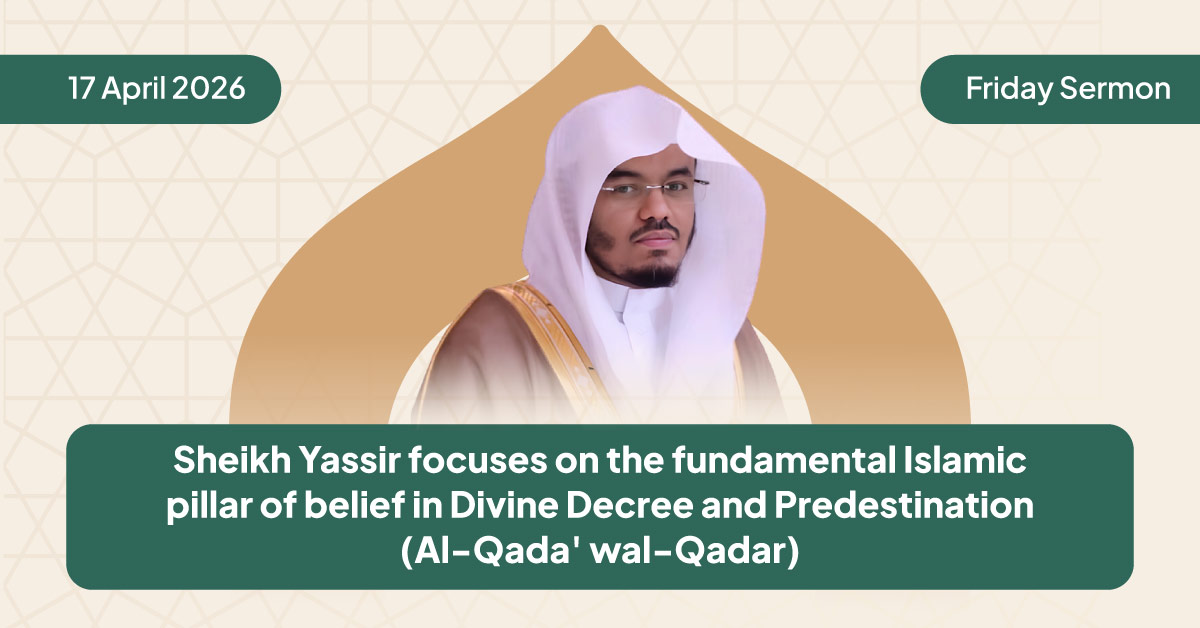
In a moving Friday sermon delivered at Masjid Al-Haram in Makkah on April 17, 2026, Sheikh Yassir bin Rashid Al-Dousari unpacked this pillar of faith with rare clarity and warmth. What follows is a reflection on those lessons — and why, in a world overrun with anxiety and comparison, they matter more than ever.
This Is Not Just Theology — It’s a Lifeline
Belief in destiny is not a side dish in the banquet of Islamic faith. It is foundational — so foundational, in fact, that the Prophet Muhammad (peace be upon him) taught that no deed, however magnificent, is truly complete without it.
Sheikh Yassir cited a striking Hadith narrated by Zaid bin Thabit: even if a person were to give gold equal in weight to Mount Uhud in the way of Allah, their charity would not be accepted unless their heart held firm belief in divine destiny. That is a staggering statement. It tells us that how we understand reality shapes the worth of everything we do within it.
And at the heart of that belief is a single, beautiful truth: what reaches you was never meant to miss you, and what misses you was never meant to reach you.
Read that again slowly. Let it settle.
The Four Levels of Believing in Destiny
Sheikh Yassir outlined that true belief in Al-Qada’ wal-Qadar is not a vague feeling — it has structure. There are four essential levels, each building on the last, that constitute complete faith in this pillar.
1. Knowledge (Al-Ilm) — Allah Knows Everything
The first level is believing that Allah’s knowledge is absolute and all-encompassing. It covers what was, what is, what will be — and even what did not happen, and how it would have unfolded had it occurred.
This is not a cold, mechanical omniscience. It is the knowledge of a Creator who is intimately aware of every flicker of feeling in your chest, every silent prayer you’ve never spoken aloud, every moment of your life — before it has even arrived.
2. Writing (Al-Kitaba) — It Was Written Before the World Began
The second level is the belief that Allah recorded the destiny of every soul in the Preserved Tablet (Al-Lawh al-Mahfuz) — fifty thousand years before the heavens and the earth were even created.
Your lifespan, your sustenance, your struggles, your joys — all of it was written. This is not fatalism; it is the recognition that the universe is not a place of random chaos. There is an Author, and the story has been written with infinite wisdom.
3. Will (Al-Mashi’ah) — Nothing Happens Outside Allah’s Will
The third level is the conviction that everything — every raindrop, every heartbreak, every unexpected act of kindness — happens only by Allah’s will. Not a leaf falls without His permission.
Crucially, this does not eliminate human agency. Sheikh Yassir was careful to clarify: we have will, we make choices, and we are responsible for them. But our will exists within, not outside of, the will of Allah. We are the ones who row the boat — He determines the sea.
4. Creation (Al-Khalq) — Allah is the Sole Creator of All
The fourth level is believing that Allah alone created everything — not only the mountains and the stars, but every human action and every unfolding event. There is no creator, no Lord, no sovereign besides Him.
Taken together, these four levels don’t shrink your world — they expand it. They place your life within a framework of meaning, care, and cosmic intentionality that no philosophy or self-help system can replicate.
What Believing in Destiny Actually Does to You
Sheikh Yassir described the fruits of this belief — and they are not abstract. They are changes you can feel in your chest, in your relationships, in the way you wake up in the morning.
It Gives You Peace You Can’t Manufacture
There is a kind of tranquility that comes from truly believing that what has passed was meant to pass, and what is coming has already been accounted for. It doesn’t mean you stop striving — it means you stop drowning in outcomes you cannot control. The believer in destiny is free from the tyranny of endless “what ifs.”
It Teaches You to Hold Both Pain and Gratitude
When hardship strikes, the person grounded in belief in destiny does not collapse into bitterness. They grieve — because grief is human and healthy — but they also find the strength to be patient, knowing that this trial is not a mistake. And when ease comes, that same person feels genuine gratitude rather than the hollow satisfaction of someone who believes they earned it entirely on their own.
It Frees You from the Poison of Envy
This might be the most relevant lesson for our time. We live in an age of comparison — social media feeds curated to showcase everyone else’s highlight reel while we privately sit with our struggles. Envy, as Sheikh Yassir reminded his congregation, is a disease of the heart. And belief in destiny is its cure.
When you truly believe that Allah distributes blessings according to His perfect wisdom — that someone else’s abundance was written for them just as yours was written for you — the sting of envy loses its power. You stop seeing other people’s good fortune as a threat and start seeing it as simply… their story.
The Prophet (peace be upon him) gave a remarkably simple prescription: look at those who have less than you, not at those who have more. Not because you should ignore ambition, but because gratitude and envy cannot truly coexist.
It Dissolves Fear — Including the Fear of Death
Your lifespan is already decreed. Your provision is already written. This does not mean recklessness — Islam commands that we take every lawful means available to us. But it does mean that the deep, existential dread of not having enough, of not being enough, of running out of time — that dread loses its grip when your heart truly accepts that your sustenance and your days were determined before you drew your first breath.
A Faith That Holds the World Together
Sheikh Yassir closed his sermon with prayers for the entire Muslim community, for the peace and security of Saudi Arabia, and with particular tenderness, for the oppressed Muslims of Palestine, asking Allah to grant them relief, victory, and a way out of every hardship.
That closing was not incidental. It is the natural conclusion of a sermon on destiny: a believer who understands Al-Qadar does not become passive or indifferent to the suffering of others. Instead, they turn toward their Lord with urgency and hope, knowing that He alone has the power to change what appears unchangeable — and that His decree includes the decree of relief.
The Question Worth Sitting With
If everything that was meant to reach you has reached you, and everything that was meant to pass you by has done so — what changes when you actually believe that?
It changes the way you hold your losses. It changes the way you celebrate your blessings. It changes the way you look at the person sitting across from you who seems to have it all. It changes the quality of your striving — because you are no longer striving out of fear, but out of a desire to honor the opportunity that was written for you.
You were never meant to miss what is yours. And what is yours — in this life and the next — is shaped by a wisdom far greater than anything we can see.
That is the gift hidden inside one of Islam’s most misunderstood teachings. And once you receive it, it changes everything.
Based on the Friday Sermon at Masjid Al-Haram, Makkah | Sheikh Yassir bin Rashid Al-Dousari | April 17, 2026