Purifying the Heart, Guarding the Sacred – Masjid al-Haram Friday Sermon 18 September 2026 (6 Rabi ul Akhir 1448 AH)
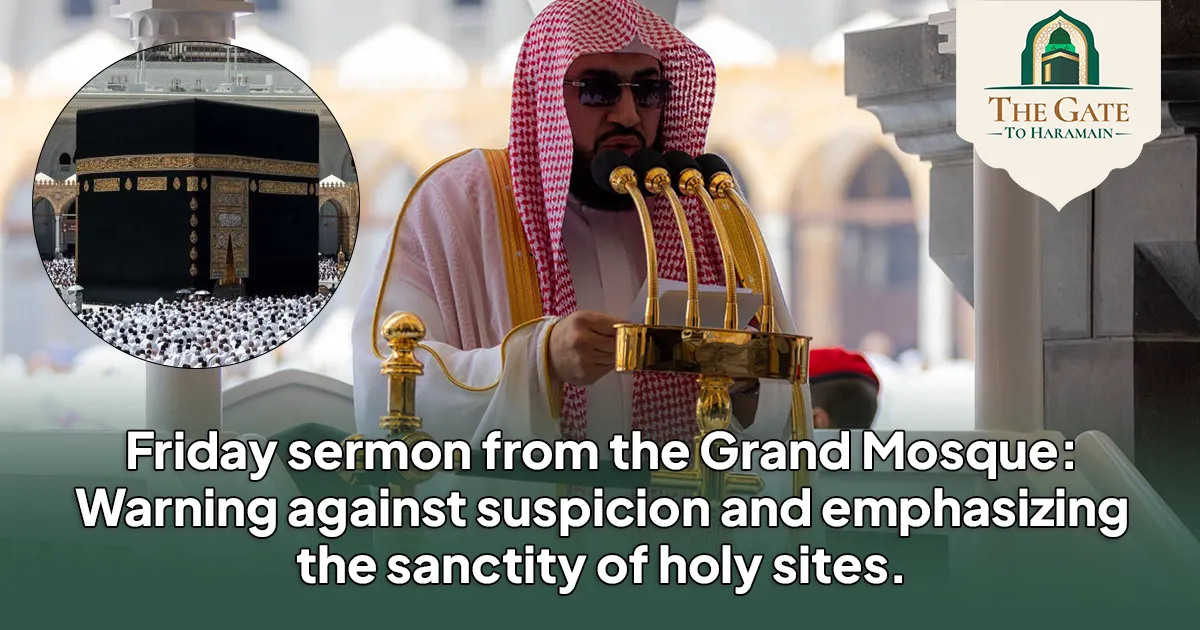
There’s a particular kind of poison that starts small. A raised eyebrow. A comment taken the wrong way. A story that gets retold with a little more edge each time it changes hands. This week’s khutbah from the Al-Masjid Al-Haram on 18th September 2026 in Makkah was about exactly that poison, and about what it takes to actually build a life free of it.
Sheikh Dr. Bandar Balila, Imam and preacher of Al-Masjid Al-Haram, used his Friday Khutbah to tackle two things that sound unrelated until you sit with them: the quiet damage of assuming the worst about people, and the not-so-quiet damage being done right now to the places Muslims hold sacred. Both, he argued, come down to the same root — what’s guarding your heart, and what isn’t.
The Weight of a Bad Assumption
Sheikh Balila did not soften this one. The Imam said that the suspicion doesn’t stay contained. Let it in, and you end up “swimming in a sea of sins and stumbling in the dark depths of illness and oppression.” That’s not a metaphor he was reaching for on the spot — it’s the language the sermon used to describe exactly how suspicion metastasizes: into spying, into backbiting, into open hostility toward people who never did anything to deserve it.
He grounded the warning in Surat Al-Hujurat (49:12), which tells believers to avoid most forms of negative assumption and asks a question that’s stuck with commentators for centuries: would you eat your brother’s flesh while he’s dead? Nobody would. And yet backbiting, the sermon pointed out, is functionally the same act — just slower, and socially acceptable.
What the Prophet ﷺ Actually Said
The sermon didn’t stop at the Quranic warning. It leaned on a hadith recorded in both Sahih Al-Bukhari and Sahih Muslim, in which the Prophet ﷺ told his companions directly: “Beware of suspicion, because suspicion is the falsest kind of speech.” Don’t go looking for faults. Don’t spy. Don’t let envy or grudges pull people apart.
Here’s the detail worth sitting with: Sheikh Balila framed suspicion as a Satanic tool, specifically effective against people whose faith is already a little fragile. It’s not random. It targets the weak spot. That’s a very different picture than “suspicion is just a bad habit” — it’s suspicion as a deliberate wedge, and Surat Al-Mujadila (58:10) backs that up, describing it as something meant to grieve the believers specifically.
Clear the Air Before It Clouds
The most human moment in the whole sermon was a story about the Prophet ﷺ himself — not a rule, a scene.
He was in i’tikaf, seclusion in the mosque, when Safiyyah bint Huyayy came to visit at night. When she got up to leave, he walked her home. Two men from the Ansar passed by, saw the Prophet ﷺ, and — out of respect — picked up their pace to give him space. He called after them: “Slow down. She is Safiyyah bint Huyayy.” They were startled. “SubhanAllah, O Messenger of Allah!” they said. His answer: “Satan runs through man like blood, and I feared he might cast something into your hearts.”
Sit with that for a second. The Prophet ﷺ wasn’t worried about what he’d done — he hadn’t done anything wrong. He was worried about the gap between what happened and what two good, well-meaning men might assume happened. So he closed the gap himself, immediately, without waiting to be asked.
Sheikh Balila’s takeaway was practical, not just devotional: don’t put yourself in a position where reasonable people might think badly of you, and if you already have, don’t wait — explain yourself now. That’s not weakness. It’s the same instinct the Prophet ﷺ modeled.
Good Faith Isn’t Optional
This is where the sermon pushed back on a common misreading. Husn Al-Zann — thinking well of others — gets treated sometimes like a nice-to-have. A spiritual bonus round for people who’ve already nailed the basics. Sheikh Balila rejected that framing outright: it’s not a supererogatory act, and it’s not optional. It’s obligatory. Owed to your spouse. Your relatives. Your neighbors. Your coworkers. And — this is the part that widens the lens considerably — owed even to your country and its leadership, because mutual trust there is what holds a society together in the first place.
The payoff, according to the sermon, isn’t abstract either: purity of the chest, tranquility of the heart, joy of the spirit, physical wellness, and — ultimately — success on the Day of Judgment. Five specific benefits, not a vague promise of “feeling better.” Surat An-Nur (24:12) is cited here as well, asking why believers didn’t think well of themselves and each other the moment they heard something questionable.
A Red Line Around What’s Sacred
The second half of the khutbah shifted register entirely. From personal conduct to a direct condemnation of violence against Islam’s holiest sites. Sheikh Balila named it plainly: the Houthi militia’s targeting of Makkah and Madinah, mosques, schools, and civilian property is, in his words, a criminal approach stripped of the most basic values of religion and humanity.
The line he drew was unambiguous. Harming the security of sacred sites, or spilling innocent blood, is a red line — full stop. Sheikh Bander Baleelah said that anyone who targets the Sacred House of Allah or the mosque of His Prophet ﷺ has proven they have no real connection to Islam, regardless of what religious language they hide behind.
The sermon closed with supplication for Saudi Arabia’s security and stability, for the sick and the indebted, for peace across Muslim lands, and for King Salman, Custodian of the Two Holy Mosques. Then the congregation stood for prayer, with the Imam reciting Surat At-Tin and Surat Quraysh — two chapters that, fittingly, both speak to safety and sanctuary.
What ties the whole khutbah together isn’t really suspicion or security as separate topics. It’s the same question asked twice: what are you protecting, and how carefully? Your neighbor’s reputation deserves that carefulness. So does the ground the Kaaba stands on. Different scale, same principle.