
Why Honesty in Trade Is a Matter of Faith, Not Just Ethics – Prophet’s Mosque Friday Sermon 11 Sept 2026 (29 Rabi al-Awwal 1448 AH)
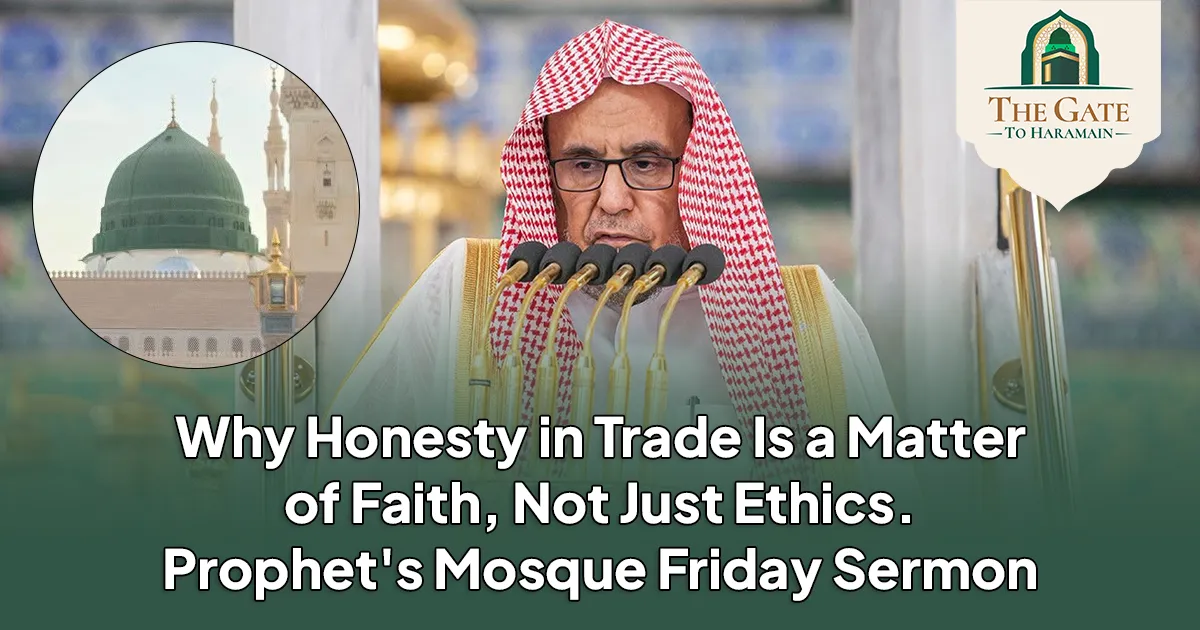
A vehicle with a hidden defect. Medicine cut with the wrong ingredients. Food labeled as one thing and sold as another. These aren’t hypothetical scenarios — they are the exact examples Sheikh Dr. Hussein Al-Sheikh, Imam and preacher of the Prophet’s Mosque in Madinah, raised in his Friday sermon.
His point was simple and uncomfortable: in Islam, cheating a customer is not a gray area or a “smart business move.” It’s a betrayal of faith itself.
That’s the thread running through the entire khutbah. Commerce isn’t separate from religion it is one of the places religion is tested most.
Three Things Islam Won’t Negotiate On
Dr. Al-Sheikh grounded the sermon in three principles he called al-usul al-qat’iyyah — the definitive foundations of how a Muslim deals with other people:
- Nush (sincere counsel) — actively wanting good for the person you are dealing with, not just tolerating them.
- Sidq (truthfulness) — in what you say, what you advertise, and what you sign.
- Amanah (trust) — treating every responsibility, from a small sale to a public office, like something you’ll answer for.
None of these are framed as nice-to-haves. The sermon calls them qat’iyyah — settled, non-negotiable — which is a stronger word than most people expect attached to something as mundane as a sales transaction.
He tied all three back to a single verse: “
And whoever fears Allah — He will make for him a way out and will provide for him from where he does not expect.” (Surah At-Talaq: 2–3).
The implication lands hard on anyone tempted to cut corners for profit: cheating someone out of fear of losing money misreads where money actually comes from.
Fraud Isn’t a White-Collar Inconvenience — It’s Named a Crime
Here’s where the Friday Sermon stops sounding like a general reminder and starts sounding like an indictment. Fraud — ghash — gets three separate labels in the khutbah: a major crime, a supreme betrayal, and corruption on earth. Not “unethical.” Not “frowned upon.” A crime.
The Prophet ﷺ put it bluntly: “Whoever cheats us is not of us.” (Sahih Muslim).
That’s not a warning about a fine or a bad review. It’s a statement about belonging.
And the sermon doesn’t stop at money changing hands unfairly. Dr. Al-Sheikh specifically named food, drinks, clothing, and vehicles as categories where fraud shows up — and then went further, pointing to counterfeit medicine and adulterated goods that cause what he described as amrad musta’siyah wa adwa’ fattakah — chronic, incurable illness. A defective part disguised as safe, a medication cut with the wrong compound: these aren’t financial crimes with a side effect. The sermon treats the harm to a person’s body as the actual crime, and the money as secondary.
That reframing matters. Most people hear “commercial fraud” and think lawsuit. The sermon wants you to think: someone’s health, someone’s family, someone’s years.
The Man Who Refused to Hide a Flaw
The most memorable part of the khutbah isn’t a ruling — it’s a story about a Companion named Jarir ibn ‘Abdillah (may Allah be pleased with him).
Whenever Jarir sold something, he’d list every defect in it before the buyer paid. Not vaguely — every single one. Then he’d say: “If you wish, take it; and if you wish, leave it.”
People around him thought this was, frankly, bad business. “May Allah have mercy on you!” they told him. “If you keep doing this, nothing you own will ever sell.” Which is a fair prediction, by most standards of salesmanship.
Jarir’s answer is the whole sermon in one sentence: “We pledged allegiance to the Messenger of Allah ﷺ on giving sincere advice to every Muslim.”
He wasn’t running a business with an ethics policy attached. The sincerity was the business — a promise he’d made that outranked the sale. It’s worth sitting with how strange that looks next to modern retail, where flaws get buried in page 40 of a terms-of-service document instead of said out loud before someone pays.
Anyone Who Manages Something for Others Is Held to This
The sermon then widens the lens beyond shopkeepers. It cites a hadith about a shepherd — someone entrusted with a flock who fails to look after it with sincerity:
There is no servant whom Allah entrusts with a flock, and he does not surround it with his sincere advice, except that he will not find the fragrance of Paradise.” (agreed upon as authentic).
Dr. Al-Sheikh applied this beyond literal herding. His reading: this covers anyone holding responsibility over a shared interest of Muslims — a manager, an inspector, a healthcare provider, a public official, a seller. If you’re in charge of something other people depend on, you’re the shepherd in this hadith, whether or not you ever touch livestock.
That’s a heavier standard than most job descriptions carry. It means the quality-control inspector who waves through a bad batch and the official who looks away from a violation aren’t just failing a performance review — they’re the subject of a specific prophetic warning.
Why Lying in a Sale Costs More Than It Earns
The sermon’s second khutbah returns to a hadith that, once you’ve heard it, is hard to un-hear the next time you’re negotiating a price:
“The two parties to a sale have the option as long as they have not separated. If they are truthful and transparent, their transaction will be blessed. But if they lie and conceal, the blessing of their transaction will be wiped out.”
Read that again: the blessing is wiped out — not reduced, not delayed. Erased.
A seller can walk away from a dishonest deal with more money in hand. The sermon’s claim is that they walk away with less than they started with, because barakah — blessing, staying power, the thing that makes wealth actually useful rather than just numerical — doesn’t survive deception. Money earned through concealment might spend the same. The sermon insists it doesn’t function the same.
The Point of All of This
Strip away the specific rulings and what’s left is a fairly direct challenge: stop treating your job, your shop, or your sale as separate from your religion. The sermon doesn’t offer a loophole for “just this once” or “it’s a small defect, they’ll never notice.” Sincerity, truthfulness, and trust are described as usul — foundations, not preferences.
Whether you’re managing a warehouse, seeing patients, running a stall, or overseeing a budget, the sermon leaves you with the same question Jarir answered centuries ago: does the sale come first, or does the promise?