
Real Love for the Prophet ﷺ Looks Like Obedience, Not Occasions: Masjid ul Haram Friday Sermon 21 August 2026 (8 Rabi’ al-Awwal 1448 AH)
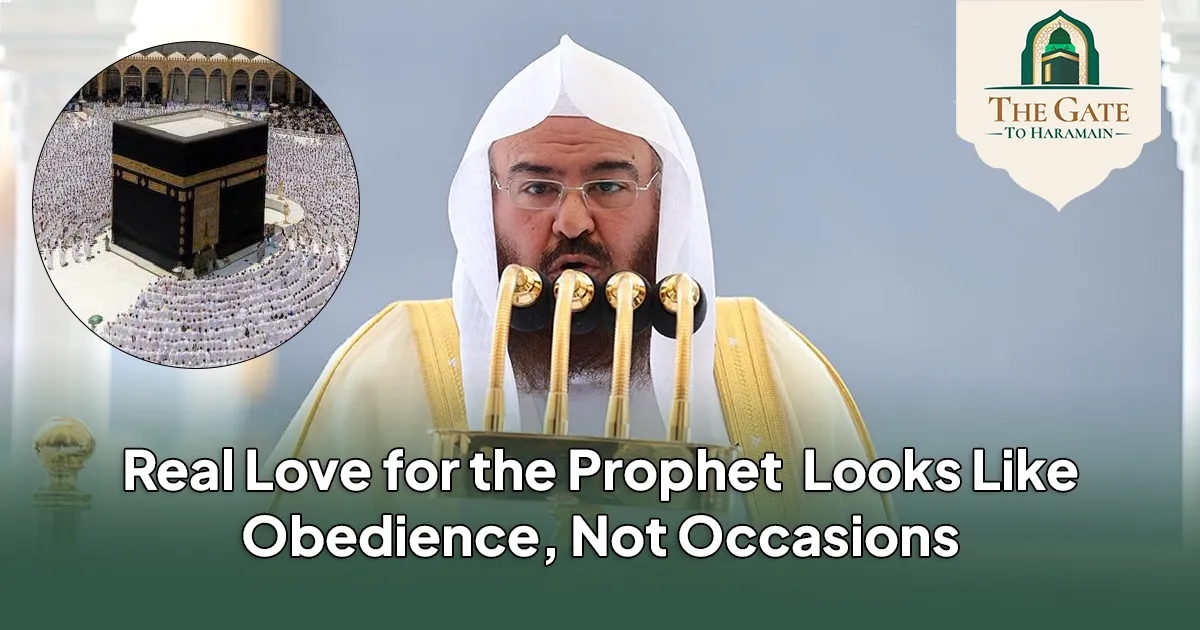
There is a moment in almost every khutbah where the speaker says something that could apply to any Friday, any year, any congregation. This one wasn’t that. Sheikh Abdul Rahman Al-Sudais stood at the pulpit of the Masjid ul Haram and told the worshippers in front of him and, by extension, the Ummah watching from wherever they were that the way they love the Prophet ﷺ has probably gotten smaller than it should be. Not less sincere. Smaller. Confined to a date on the calendar, a post on a feed, a mood that shows up once a year and leaves.
He opened the way these sermons usually open: praise for Allah, a reminder to hold on to taqwa whether anyone is watching or not. Then Sheikh Sudais took the congregation back fourteen centuries, to the start of a mission he described as having perfumed entire regions with its arrival. Not a metaphor he rushed past, either; he built on it, calling the Prophet’s ﷺ biography a historical treasure, a civilizational wellspring, a scientific methodology, and a practical ladder, all at once. Four different lenses for the same life, each one doing different work.
What “love” actually requires
Here’s where the sermon stopped being comfortable. Al-Sudais didn’t let “love for the Prophet ﷺ” stay abstract. He cited the hadith agreed upon by Bukhari and Muslim that none of you truly believes until the Prophet ﷺ is more beloved to you than your own child, your parent, all of mankind, and then went further, to the hadith that ties belief to alignment: your desires have to match what he brought, not the other way around.
That’s a much harder standard than admiration. Admiration costs nothing. He quoted Surah An-Nisa, verse 65, the one about not truly believing until you accept the Prophet’s ﷺ judgment without discomfort, and Surah Al-Ahzab, verse 21, on the excellent pattern he sets for anyone whose hope is in Allah and the Last Day. The throughline across all of it: love that doesn’t show up in behavior isn’t the love the texts are describing.
A pulpit talking directly to your phone
The part of the Friday khutbah that will probably get quoted the most this week is the section aimed squarely at content creators and social media influencers. Not a passing mention but a direct charge. Sheikh Sudais told them plainly that their reach comes with responsibility: spread the authentic Sunnah, not distorted fragments of it. Use their platforms to strengthen tawhid and model moderation. Apply the Prophet’s ﷺ guidance to modern crises using real scholarly method, not guesswork dressed up as confidence. And guard against both extremes: the innovation and excess on one side, the apathy and negligence on the other.
It is a striking thing to hear from the historic minbar of Al-Masjid al-Haram. Digital platforms get treated, in a lot of religious discourse, as a distraction from real devotion. This sermon flipped that. It named influencers as people doing real work with real consequences, for better or worse, and asked them to take that seriously.
The trap of “seasonal” devotion
In the second part of the Friday Sermon, Sheikh Sudais turned to something he clearly wanted the congregation to sit with: the difference between loving the Prophet ﷺ and performing that love on schedule. His words were direct: the Ummah’s connection to its Prophet and his fragrant sira is not a matter of times, occasions, appearances, and formalities. It is a close bond that holds in every circumstance, every affair, every state of life, until death.
He backed it with two of the most repeated warnings in the prophetic tradition: whoever innovates in this matter of ours what is not part of it, it is rejected. Whoever does a deed not in line with our matter, it’s rejected. Sheikh Sudais said that the cure for that drift isn’t political and it isn’t cosmetic. It is knowledge — real, foundational, correctly sourced knowledge. Which is why, with a new academic year starting, he tied the pursuit of learning directly to the pursuit of the Prophet ﷺ himself, and asked teachers to carry that responsibility with sincerity and trustworthiness, not just competence.
Closing with salawat and dua
Before moving into supplication, Sheikh Abdul Rahman Al-Sudais returned to something simpler and warmer: the habit of sending salawat on the Prophet ﷺ. He reminded the congregation at the Masjid Al Haram that persistence in this removes worry and relieves distress, and recited Surah Al-Ahzab, verse 56 where Allah and His angels send blessings upon the Prophet ﷺ, and believers are asked to do the same.
The dua that followed covered familiar ground and one that never gets easier to hear: prayers for the strength and preservation of Muslims everywhere, for Saudi Arabia’s safety and its leadership, for the security forces who guard it, for the sick and the indebted and the distressed and, closing it out, a plea for Al-Aqsa and for the Palestinians still living through what they’re living through.
In prayer, the Imam recited Surah Ali ‘Imran, verses 31–32, in the first rak’ah, the verse that ties loving Allah directly to following the Prophet ﷺ, and Surah Al-Kawthar in the second. It is hard not to notice how deliberately that choice echoed everything that came before it.
Coverage from The Gate To Haramain, sourced from the Friday khutbah broadcast at Al-Masjid al-Haram.