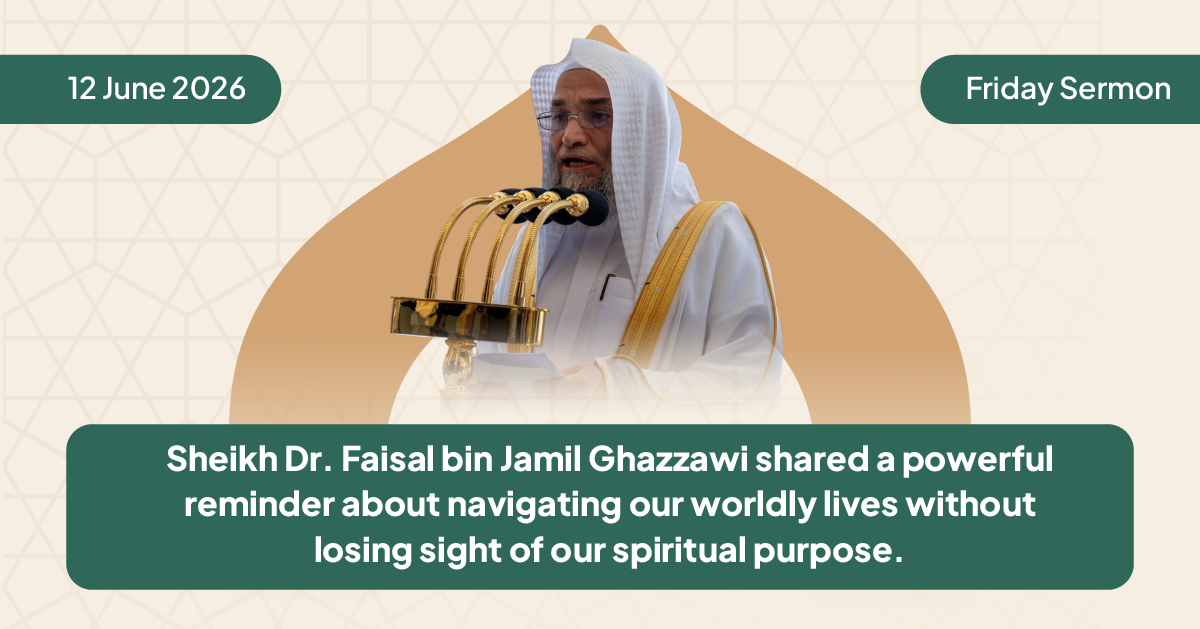
Sheikh Faisal Ghazzawi Calls for Spiritual Balance 12 June Friday Sermon
You’re Working Yourself to Death for Something That Won’t Last
There is a particular kind of exhaustion that has nothing to do with sleep.
You know the one. You hit your targets, close your deals, upgrade your apartment, and somewhere between the celebration and the hangover, a quiet thought surfaces: Is this it? Not depression, not ingratitude, just a crack in the story you have been telling yourself about why you are running so fast.
The Imam of the Grand Mosque, The Imam of the Grand Mosque, Sheikh Dr. Faisal bin Jamil Ghazzawi, put his finger on it in last Friday’s sermon. Not in the language of self-help or productivity Twitter, but in something older and more honest. He described this world, our world, the one we hustle through, as something whose “beginning is hardship and whose end is annihilation.” It is coming is deception, he said. Its turning away is a tragedy.
Harsh? Maybe. But also undeniable.
We do not talk about impermanence much. Not really. We acknowledge it in theory, sure, nothing lasts forever, yeah, yeah, and then we go right back to optimising for things that will not survive us. The bigger house. The next title. The approval we’ve been quietly chasing since we were twelve.
The sermon quoted the Quran describing worldly life as rain. It falls, things grow, you get briefly excited, and then it dries up and turns yellow. That is the whole arc. The Quran is not being pessimistic; it is being accurate. Anyone who’s watched something they worked years to build unravel in a season knows exactly what that image means.
What gets me about this framing is what it does not say. It does not say: therefore, stop working. It doesn’t say: give everything away and sit in a room. The Sheikh Faisal Ghazzawi was direct about this: asceticism doesn’t mean withdrawal. The believer is commanded to cultivate the earth, earn honestly, and enjoy what God has permitted. The point isn’t misery. The point is not being deluded.
There is a difference between someone who builds something beautiful, knowing it’s temporary, and someone who builds the same thing, believing it will save them. The first person can put it down. The second one can’t.
Ibn al-Qayyim, the 14th-century scholar, had a line that the Imam quoted that I keep turning over. He said the world itself isn’t condemned, it’s the field of the Hereafter. What you grow here, you harvest there. Every act of faith, every moment of genuine love, every time you chose honesty when lying would have been easier, that doesn’t disappear. It compounds somewhere you can not yet see.
That reframe changes everything about how you move through a day. Not as someone counting down to escape, but as someone planting things that matter.
The sermon ended with something one of the early wise men said: how can a person rejoice in this world when their day destroys their month, their month destroys their year, and their year destroys their life?
It sounds bleak until you realise it’s actually the most clarifying question you can sit with. Not to make you anxious, but to make you honest. About what you are spending your days on. About whether the thing you’re so tired of is actually worth being tired for.
The passing of time isn’t just a fact. It’s an argument. One of the Imams said, “the most eloquent of admonitions for those with understanding.”
I think most of us understand it. We keep hitting snooze.
This post draws on the Friday sermon delivered at the Grand Mosque, Makkah.