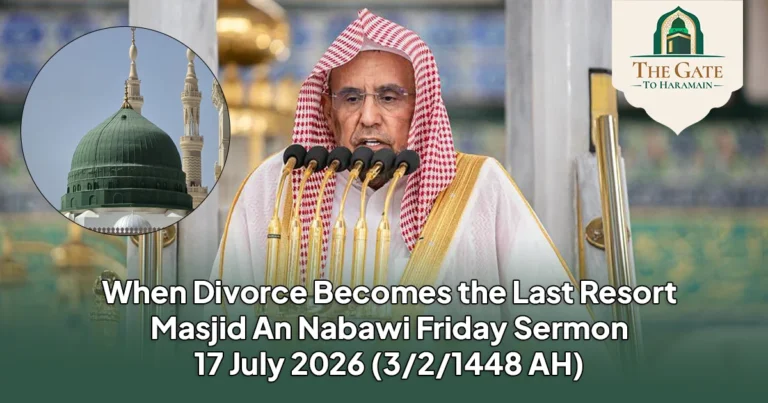
What Haya’ Actually Means: Masjid An Nabawi Friday Sermon 14 August 2026 (1 Rabi’ al-Awwal 1448 AH)
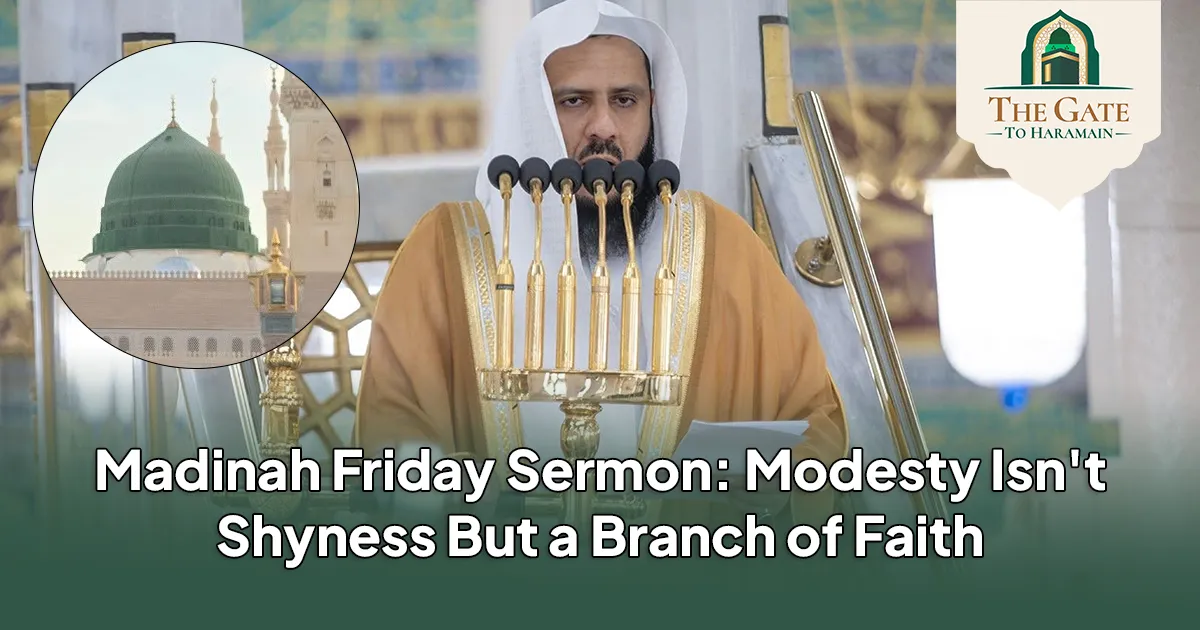
Every Friday, believers gather to recalibrate their hearts, seeking timeless wisdom to navigate the complexities of modern life. In a Friday sermon from the Prophet’s Mosque in Madinah (1448-03-01H), the Sheikh Khalid Muhanna took on a virtue most people flatten into a single word: shy.
That’s not what Haya’ means. And the sermon spent most of its length making the case for why the gap matters.
One of Seventy-Odd Branches
Sheikh Khalid Muhanna opened with the well-known hadith: faith has seventy-odd branches. The highest is “La ilaha illa Allah.” The lowest is clearing a harmful obstacle off the road. Modesty sits somewhere in between, but it’s a branch, not an accessory bolted onto faith from outside.
It’s woven into belief the same way deeds, words, and morals are. And it behaves almost like an internal compass: pulling a person toward what beautifies their character, pushing them off whatever would stain it. The sermon framed gratitude itself this way — obedience isn’t really a rule being followed; it’s shame at wasting a blessing doing its quiet work.
Two Directions
Haya’ splits into two dimensions, and they don’t run on the same axis.
Modesty before Allah is vertical. It shows up when someone actually feels the weight of Allah’s names and attributes, not abstractly, but as something real. It looks like refusing to turn His blessings into tools for disobedience, paired with a self-respect that won’t settle for spiritual mediocrity.
Modesty before people is horizontal, tied to muru’ah chivalry, honor, the texture of upright character. It’s what keeps someone from bragging about something shameful, from coveting what isn’t theirs, from letting family ties go slack or turning away a brother in need.
Take both away, the Sheikh warned, and what’s left of a person is just a body. The substance is gone.
The Two Springs
Two things feed it.
The first is muraqabah, living with the felt, constant awareness that Allah is watching. It’s the state behind the Quranic reminders: “Does he not know that Allah sees?” and “Indeed, Allah is ever over you an Observer.” Carry that awareness, and modesty stops taking effort. It becomes reflex.
The second is taqseer: an honest look at how far short your worship falls, next to what Allah actually deserves. Pray, fast, give as much as you want; it still won’t match the blessings arriving constantly. Sitting with that gap, instead of looking away from it, is what produces real humility.
Born With It, or Built
For some, modesty is just temperament, a gift they didn’t earn. For others, it’s built through mujahadah, deliberate effort, steering the soul away from ugliness again and again until it stops feeling like effort at all.
Either way, once it takes root, it covers behavior in public and in private alike. As the Prophet told Mu’awiyah ibn Haydah: “Allah is more worthy of your shyness than people.”
Written Into the Prophets
The sermon pointed to a few examples. Musa (peace be upon him) was described as so modest he kept himself fully covered, careful about exposing even his skin. The Prophet Muhammad ﷺ, according to his companion Abu Sa’id al-Khudri, was more modest than a virgin in her private quarters; if something displeased him, it showed on his face before he said a word. And the Quran singles out the daughter of Shu’ayb for exactly this quality: “Then one of the two women came to him walking with shyness.”
A Heart Without It Is a Dead Heart
Here the sermon turned blunt: losing Haya’ isn’t a minor character flaw. It’s a symptom of something dead.
The word Haya’ shares a root with hayah: life. Ibn Taymiyyah made the connection directly: a living heart carries modesty, and that modesty is what keeps it from ugliness. Kill the modesty and the heart goes with it. At that point, a person becomes capable of anything.
The Prophet ﷺ, quoting the earlier prophets, put it plainly: “If you feel no shame, then do as you wish.” Lose haya, and it isn’t just one virtue gone; it’s dignity traded for disgrace and public suspicion. Mujahid ibn Jabr put it best: “If a believer gained nothing from their faith except modesty, it would still stand as a sufficient barrier against sin.”
Universal, Not Uniform
Sheikh Khalid Muhanna closed by describing Haya’ as something everyone needs, though it does different work for different people. For men, it protects religious commitment and standing. For women, it’s described as the height of dignity and honor.
The sermon ended in dua asking Allah to beautify the congregation’s faith, guide them to the best of character, bring relief to the oppressed in Palestine, protect Muslim lands, and guide their leadership toward righteousness.