Sheikh Al-Sudais on AI, Rumours and Every Share: Masjid Al Haram Friday Sermon 9 Oct 2026 (28 Rabi ul Akhir 1448 AH)
Picture this. A voice message arrives from your cousin. It’s his voice, down to the way he clears his throat before asking for a favour. He needs money, and he needs it within the hour. Now a second message. A clip of a scholar you respect saying something outrageous. Forty people in your family group have already reacted. Your thumb sits over “forward.”
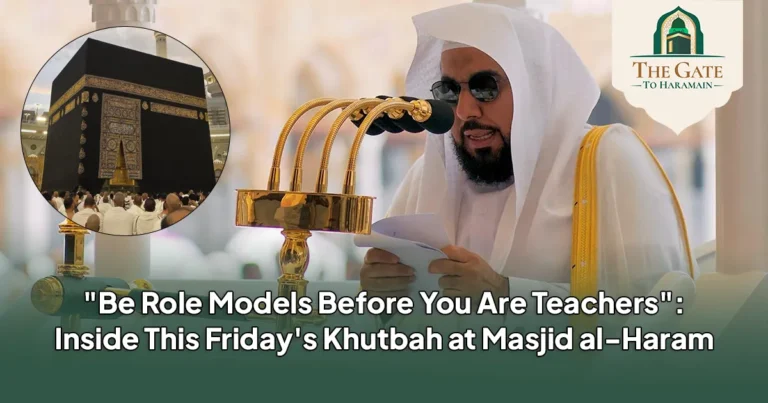
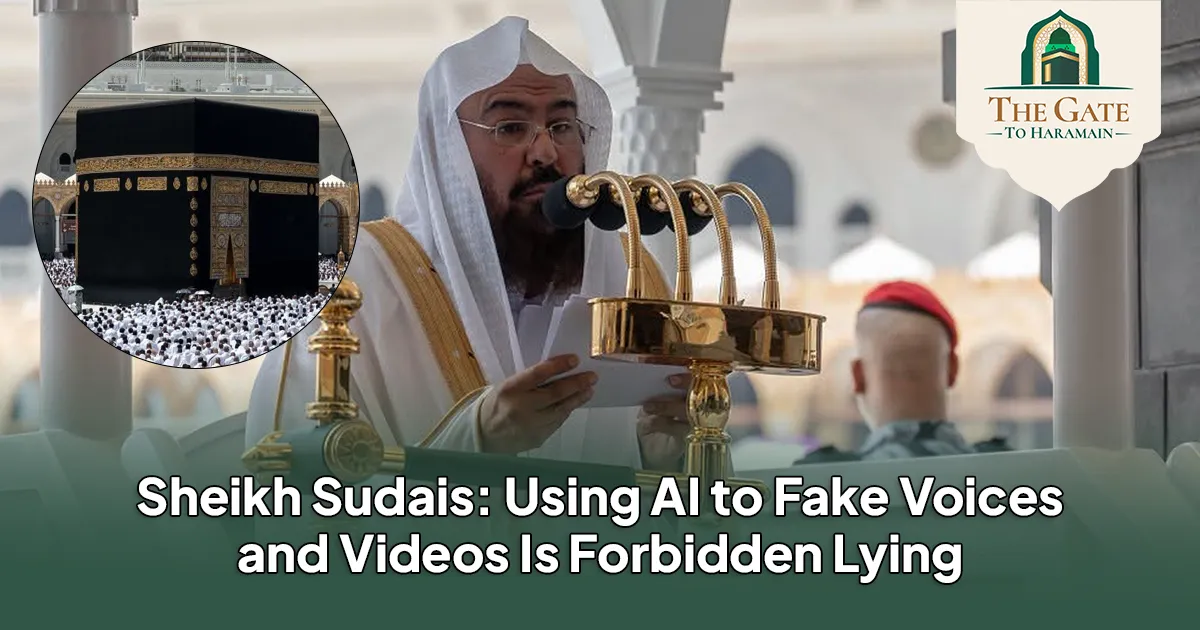
Both moments sit at the centre of the Friday sermon at Masjid Al Haram on 9 October 2026. Sheikh Dr. Abdul Rahman Al-Sudais, Imam and preacher of the Grand Mosque, told worshippers that AI and social media are blessings from Allah, that faking videos and voices is lying Islam forbids, and that everything you write, say, repost or share is recorded and will be questioned.
One quick point on sourcing. This article draws on two written accounts of the khutbah, not an official transcript. Where only one account carries a detail, I say so. Check any quote against the Arabic text or the recording before you repeat it.
What the Friday Sermon at Masjid Al Haram on 9 October 2026 Covered
The first khutbah began by calling Islam a complete way of life, with principles that reach into money, speech and technology. The rest of the sermon followed five threads:
- Technology and AI as gifts that call for gratitude and self-checking.
- The damage online spaces cause when accountability disappears.
- The weight of a single word, including a reposted one.
- A direct ruling against AI forgery, plus a list of digital crimes.
- Unity, security and a long closing prayer.
A Blessing With a Duty Attached
The Sheikh didn’t cast phones or AI as villains. He called them favours from Allah, and a favour asks for thanks.
Thanks, in this sermon, isn’t just saying the word. One account spells it out in three parts:
- The heart remembers where your hands, your phone and your voice came from.
- The tongue is used for truth, good advice and remembrance.
- The limbs stay away from harm, from a cruel comment to a scam link.
Behind all three sits the awareness that Allah sees. Nobody watches what you do behind your screen, but the sermon reminded listeners that Allah knows the treachery of the eyes and whatever the hearts hide.
That framing rejects two lazy positions at once. Technology isn’t evil, and it isn’t neutral either. What you do with it counts.
The Problem: Lies Move Fast, Corrections Crawl
Without moral accountability, the sermon warned, online spaces turn into places that wear down family ties and community trust. The Sheikh named attacks on people’s honour, minds and money, and he listed what follows when misuse spreads: privacy violations, fraud, confusion, lost trust, weaker community security and discord.
One account also uses a classical word, Ruwaibidah, for careless and ignorant people who speak loudly about weighty public matters.
Is that picture overdrawn? The numbers say no. The FBI’s Internet Crime Complaint Center reported losses above $20.8 billion for 2025, a 26% rise on the year before, from more than a million complaints. Its report, released in 2026, also carried an AI section for the first time, tying over 22,000 complaints to nearly $893 million in losses. The full report sits on the IC3 website.
A fair limit: those are US complaints, so they can’t tell us how Muslim communities fare in particular. But the patterns, from investment schemes to impersonation, match the harms the Sheikh named.
One Word, Two Edges
The sermon spent real time on the word. One account quotes the speaker’s own images: a rising sun or a burning fire, a refreshing rain or a ruinous flood, a gift of honour or an arrow of crime.
Then came the evidence.
- A hadith recorded by Al-Bukhari says a person may speak a word pleasing to Allah without thinking much of it and be raised in rank, and another may speak a displeasing word just as casually and fall into Hellfire. Read it on Sunnah.com.
- Surah Qaf, verse 18 says no word leaves a person without a watcher ready to record it.
- Islamic law shows how much a few words can do. They can declare faith, begin a marriage or end one.
The part that fits our era best is the sermon’s treatment of resharing. The Sheikh said everything a person writes, says, republishes or shares is open to questioning. He cited Surah Al-Hujurat, verse 6, which tells believers to investigate news brought by a disobedient person, so they don’t harm others out of ignorance and regret it later. He also quoted the Prophet, peace be upon him: it is enough of a lie for a person to repeat everything he hears.
My own reading is simple. Forwarding a clip means telling everyone in your contacts, “I vouch for this.” Few of us would say that aloud about something we haven’t checked.
Deepfakes, Voice Cloning and a List of Digital Wrongs
Here the sermon gets specific. Using AI or computer tools to fake videos, copy voices, put statements in someone else’s mouth or attach images to the wrong person is lying that Sharia forbids. It’s also an attack on honour and privacy, and it helps falsehood spread.
Then the second khutbah turned to crimes. The Sheikh warned against:
- Blackmail and defamation.
- Fabricated videos and rumours that spread slander.
- Online fraud and hacking aimed at people’s money, including messages that promise quick riches and commercial cover-ups.
- Content that spreads hatred, intolerance, atheism or indecency.
Naming the tools matters. It closes the loophole of calling a fake “just a prank” or “just a filter.”
A hypothetical to make it concrete
Imagine Bilal, a schoolteacher. A clip hits his parents’ group chat showing a well-known preacher apparently insulting a neighbouring community. Bilal is furious and forwards it with a line of outrage. Twenty minutes later, a colleague points out the audio doesn’t match the preacher’s real recordings. Bilal deletes his post, but eleven parents have already copied it elsewhere.
Bilal is fictional. The pattern isn’t. He didn’t build the fake. He just carried it further than its maker ever could.
Honour Above the Kaaba, and a Word to Anonymous Accounts
One account of the sermon carries a passage the other doesn’t. The speaker recalled the Prophet’s warning, recorded by At-Tirmidhi and Ibn Hibban, against harming Muslims, reviling them or spying on their private faults. He also recalled Abdullah ibn Umar, who looked at the Kaaba and said how grand it is and how sacred its sanctity, then added that a believer’s sanctity is greater with Allah.
Set that beside the habit of digging up someone’s personal details to shame them online. The standard is hard to miss.
The same account says the Sheikh then spoke straight to people who attack honourable people from behind assumed names. His call: repent to your Lord, weigh what your hands write, and stop harming Muslims.
Anonymity changes who can see you. It doesn’t change who is watching. So here’s a test worth keeping: before you post under any name, ask whether you’d sign it.
Case Study: Old Footage, New Panic
Here’s a real example that needs no AI at all. On 16 September 2026, the fact-checking outlet Newschecker examined a viral video said to show Saudi Arabia intercepting a Houthi drone over Makkah. A reverse image search found the same footage online on 12 September 2025, linked to an incident near the Prophet’s Mosque in Madinah. It was old footage, not the event people claimed.
It’s not the first time a rumour has touched the Haramain. In September 2022, reports claimed robots would take over the call to prayer at the Grand Mosque. Newschecker traced the claim and found the official Haramain Sharifain account calling the reports incorrect and saying the robots were information guides.
Look at what these cases share. A mislabelled clip is enough to stir panic, and no deepfake was needed. That’s the exact risk the Sheikh named when he urged people to verify news, images and videos before circulating them. AI just makes the fakes harder to spot.
Unity and Security: The Second Half of the Khutbah
The Sheikh said Islamic law came with unity and harmony and rejects division. He cited the verse about holding fast together to the rope of Allah, and he urged worshippers to stand against attempts to sow discord, including fabricated clips and statements aimed at leaders, symbols and scholars. He also called for using modern tools to serve religion and the nation, and for raising awareness of illegitimate uses.
He then condemned the attacks by the Houthi group on Makkah and Madinah, calling them a clash with Sharia, a provocation of Muslims’ feelings and a breach of international norms. The security and sanctity of the Two Holy Mosques, he said, is a red line. This article reports those statements as the write-ups give them and doesn’t verify them independently.
The sermon closed with a long prayer for the safety and stability of Saudi Arabia, for its leadership and its security forces, for the unity of Muslim hearts, and for relief for the distressed and the sick.
Before You Press Share: A Five-Step Routine
- Pause for ten seconds. Ask who gains if this spreads.
- Find the original. Look for a named outlet or an official statement, not a screenshot of one.
- Check the date. A reverse image search takes under a minute and would have caught the Madinah clip.
- For any urgent money request, hang up and call back on a number you already have. Agree a private code word with close family.
- If you’ve already shared something false, delete it, post a correction in the same group and ask Allah for forgiveness.
Common Mistakes
- “I only forwarded it.” Passing a claim along makes you part of its reach.
- “It was just a joke.” A fake clip of a real person’s voice can do real harm.
- “Nobody knows who I am.” The sermon answers that one directly.
- “I’m warning people, so it’s fine.” Sharing a scary unverified clip still spreads it. Share the correction instead.
Your Next Step
Pick the busiest family or community chat you’re in. Today, post one line: “Let’s verify before we forward.” Then run the routine the next time something alarming lands.
That small habit is the practical heart of the Friday sermon at Masjid Al Haram on 9 October 2026. Your tools are gifts, your words are recorded, and every share is a statement you own.
The takeaway: before it leaves your hand, ask whether you’d stand behind it in front of Allah.