
“Be Role Models Before You Are Teachers”: Masjid ul Haram Friday Sermon 28 August 2026 (15 Rabi al-Awwal 1448 AH)
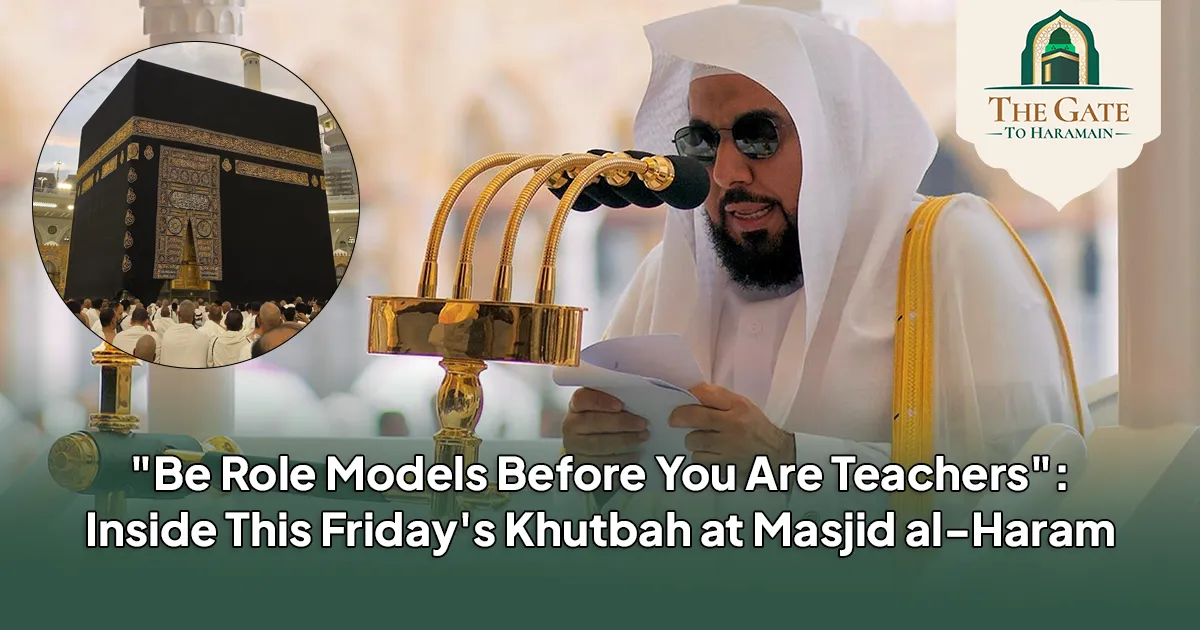
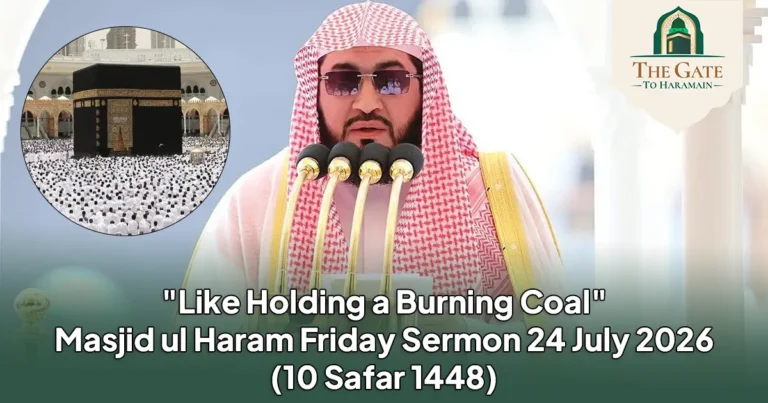
This Friday, 15 Rabi’ al-Awwal 1448 AH (29 August 2026), the khutbah at Masjid al-Haram in Makkah came from Sheikh Dr. Abdullah bin Awad Al-Juhani, Imam and preacher of the Masjid ul Haram. The Khutbah had one argument running through it from the opening line to the closing dua: knowledge that doesn’t shape your character isn’t really knowledge. It’s just information you’ll answer for.
That’s a hard thing to hear in a world obsessed with credentials. It’s also, according to this khutbah, exactly the point.
Taqwa first, everything else after
Today Sheikh Al-Juhani opened by describing Taqwa, God-consciousness, as the one piece of advice worth giving anyone, in private or in public. He called it the essence of all matters, the sum of all goodness, the source of success. No exaggeration there, as far as the sermon is concerned. Every believer built their life around it, or they didn’t build much of anything at all.
From there he went to first principles: Allah created mankind and jinn to worship Him, full stop. He quoted Surah Adh-Dhariyat: “And I did not create the jinn and mankind except to worship Me. I do not want from them any provision, nor do I want them to feed Me.” But he added a condition that shapes the whole rest of the sermon: worship only counts when it’s paired with real understanding of the religion. Good intentions without knowledge aren’t enough.
Knowledge has to come before the deed
The sermon leaned on Surah Muhammad, verse 19: “So know that there is no deity except Allah and ask forgiveness for your sin…” Sheikh Al-Juhani pointed out the order of that sentence isn’t an accident. Allah says “know” first, then “ask forgiveness.” Knowledge before action, every time. You can’t seek forgiveness properly for something you don’t understand.
Then came the line that made this sermon more than a general reminder to study your religion. Sheikh Al-Juhani cited the well-known hadith that seeking knowledge is an obligation on every Muslim, and he split that obligation into two categories. The first is what you’d expect: creed, prayer, fasting, charity, Hajj. The basics every Muslim needs to worship correctly.
The second category is the one worth sitting with. Sheikh Juhani said that every professional has to learn the specific religious and ethical rules of their own field. A trader has to know the fiqh of buying and selling. A doctor and an engineer have to know the legal and ethical boundaries of medicine and engineering. Not as a nice-to-have. As a personal obligation, the same category as prayer. Miss it, and you risk falling into what’s forbidden without even realizing you crossed the line.
Who scholars are, and what they’re actually defending
The middle of the khutbah turned to scholars, and the language got noticeably more elevated. Sheikh Al-Juhani called them inheritors of the prophets, lamps in darkness, God’s proof on earth, the backbone of the nation. He backed it with the ayah from Surah Ali ‘Imran where Allah calls “those of knowledge” as witnesses to His Oneness, alongside the angels. That’s not a small honor to hand out.
But the sermon didn’t stop at praise. It described scholars as a kind of shield, defending sound religion on three fronts at once: against the distortion of extremists who read the religion too harshly, against the false claims of people who fabricate doctrine outright, and against the misinterpretation of the ignorant who mean well but get it wrong. Three different failure modes, three different dangers, and scholars standing against all of them at the same time. It’s a framing worth remembering next time someone tries to settle a religious argument with a half-understood verse.
He also brought in the hadith from Abu Dawud comparing a scholar’s rank to the full moon among stars, and noted that Saudi Arabia’s investment in scholars and education is treated as part of the Kingdom’s own development strategy, not separate from it.
Three people, one school year
The second half of the sermon shifted to something more immediate: the new academic year. Sheikh Al-Juhani addressed three groups in turn.
Teachers first, and he gave them a line that’s hard to forget: “Be role models before you are teachers.” Not because content doesn’t matter, but because students absorb who you are before they absorb what you say.
Parents next. He described the home as the first classroom, the place where children learn honesty, respect, and the habit of prayer, before school ever gets involved.
And students, last, who he told to begin the year with resolve, good manners, and ambition, in that order.
The story that anchors the whole sermon
To make the case that character has to come with knowledge, not after it, Sheikh Al-Juhani told the story of Sufyan Al-Thawri’s mother. She gave her son money to study, ten hadiths at a time, on one condition:
“Take these dirhams and learn ten Hadiths. If you see that this knowledge improves your moral character, your conduct, and your speech with people, then continue, and I will support you in seeking it. But if it does not positively affect your behavior, then abandon it, for I fear it will become an argument against you on the Day of Resurrection.”
That’s a mother tying her financial support to her son’s character, not his grades. Sheikh Al-Juhani used it to make the sermon’s central claim explicit: “If knowledge is devoid of moral character, it becomes an argument against its possessor; but when joined with noble conduct, it becomes light and a beneficial fruit.”
He tied the same idea to raising children, and this part is worth quoting in full, because it reframes upbringing as something you do, not something you say: “Upbringing is not commands thrown around, but a role model seen every day: truthfulness in the home, mercy in interactions, preservation of prayer, and apologizing when making a mistake. Ethics is a lived life before it is a spoken lesson.”
Apologizing when you’re wrong, named specifically, as part of raising a child. Not a small detail.
The prayer itself
After the khutbah, the Iqamah was called, and rows were straightened with the familiar instructions, “Stand straight, align your rows, close the gaps.” The Imam led the two rak’ahs of Jumu’ah, reciting Surah Al-A’la in the first and Surah Al-Ghashiyah in the second, closing with the Tasleem.
Sheikh Al-Juhani closed the khutbah with supplications: for righteousness in the next generation, for patience and support for parents and teachers, for the glory of Islam, for the protection of Saudi leadership, and for the soldiers stationed at the borders.
Why this one is worth remembering
Most Friday sermon summaries land on the general reminder to seek knowledge. This one went further, and that’s what makes it worth carrying past today. It said your obligation to learn doesn’t stop at the mosque door. It follows you into your clinic, your trading floor, your classroom. And whatever you learn there only counts for something if it changes how you treat people.
Sufyan Al-Thawri’s mother understood that centuries ago. This khutbah was, in part, a reminder that we still haven’t fully caught up to her.