The Path to Real Happiness: Prophet’s Mosque Friday Sermon 7 August 2026 (24 Safar 1448)
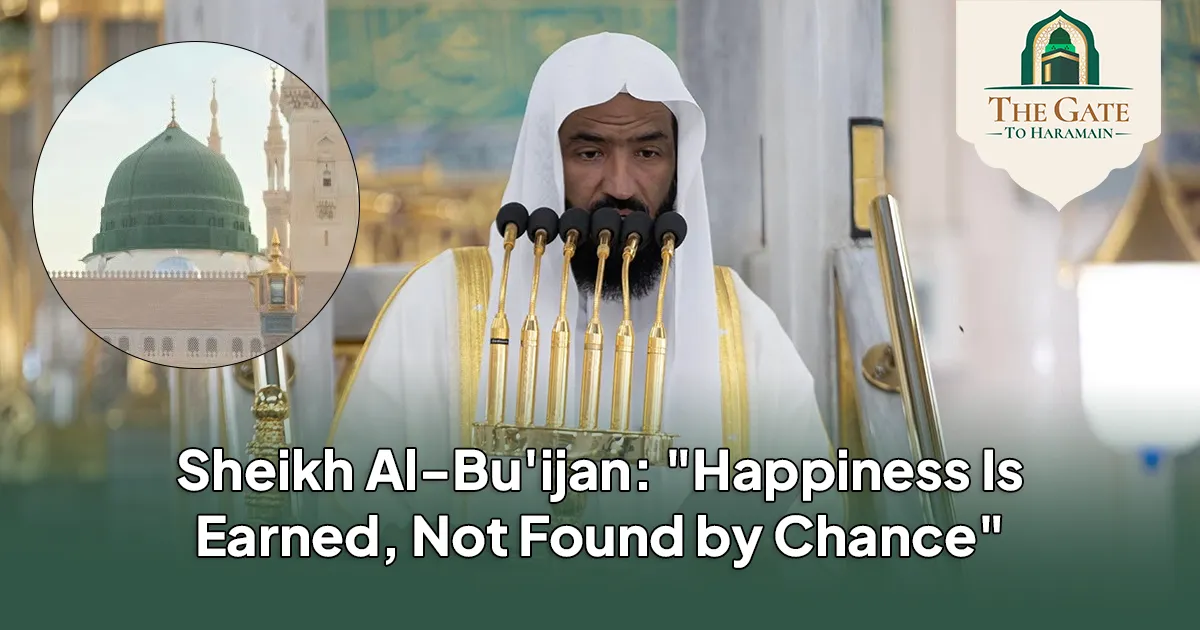
Sheikh Abdullah bin Abdulrahman Al-Bu’ijan, Imam and Khateeb of Masjid an-Nabawi | Friday, 24 Safar 1448 AH (7 August 2026)
Every human being is chasing the same thing, whether they would put it in these words or not: a settled heart. That was the starting point of this week’s khutbah at Masjid An Nabawi in Madinah, where Sheikh Abdullah bin Abdulrahman Al-Bu’ijan opened with a great reminder. He said that taqwa, mindfulness of Allah, is the key to every good thing a person could hope for, happiness included. He grounded it in the ayah: “And whoever fears Allah, He will make for him a way out, and will provide for him from where he does not expect” (Qur’an 65:2-3).
Happiness Is Not a Wish. It is Earned
Sheikh Abdullah Bu’ijan began by naming something everyone already senses: happiness is the goal nearly all of humanity is quietly pursuing. It’s woven into human nature. But wanting it and understanding it are two different things, and he pointed out that plenty of people go looking for it down the wrong roads entirely.
Khatib of the Prophet’s Mosque explained that real happiness isn’t stumbled upon. Islam has already mapped the route, the causes, the conditions, the practical steps. It comes down to a simple equation the khutbah returned to more than once: faith paired with righteous action. As the Quran puts it in Surah An-Nahl, “Whoever does righteousness, whether male or female, while being a believer — We will surely cause him to live a good life” (16:97).
Turn away from that path, though, and the Sheikh Abdullah Bu’ijan warned it leads somewhere narrower and heavier: a “straitened life,” restlessness that no amount of outward comfort can fix.
Four Things That Actually Build It
The khutbah at the Prophet’s Mosque today laid out where genuine contentment comes from not luck, not circumstance, but a handful of deliberate practices:
- Iman first. Faith is the foundation everything else sits on. Without it, nothing built on top holds.
- Salah, kept consistently. The five daily prayers are described as the believer’s direct line to Allah — a habit that clears the mind and guards the heart at the same time.
- Dhikr and the Quran. “Those who believe and whose hearts find rest in the remembrance of Allah — verily, in the remembrance of Allah do hearts find rest” (13:28). The Sheikh framed this as something closer to medicine than ritual.
- Good character and generosity toward others. Kindness, he noted, tends to circle back to the person offering it.
Letting Go of “What If”
One of the more striking parts of the khutbah dealt with regret. The Sheikh spoke about belief in qadar divine decree as a pillar of faith with real, practical mental-health weight. When something goes wrong, the instinct is to spiral into “if only I’d done it differently.” He cited the hadith of Abu Hurairah, in which the Prophet ﷺ counseled against that exact response, teaching instead to say “Allah has decreed, and what He wills, He does” because, as the hadith warns, dwelling on “if only” opens a door that’s better left shut.
The Heart, Not the Highlight Reel
The Sheikh was direct about what happiness isn’t: it isn’t luxury, comfort, or chasing every desire that crosses your mind. A person can have all of that and still feel hollow. Genuine happiness, he said, lives in the state of the heart: its stillness, its soundness, and its effects ripple into both this life and the next.
He named the conditions that block it just as clearly: jealousy, hatred, and arrogance top the list, alongside neglecting one’s obligations, harboring bad assumptions about Allah, and drowning in doubt or despair. Citing the well-known hadith of Nu’man ibn Bashir, he reminded the congregation that the heart is the body’s compass when it’s sound; everything follows; when it’s corrupted, everything else suffers with it.
He also singled out something painfully familiar: wasted time. Scrolling, distraction, chasing whatever’s trending all of it, he said, pulls a person further from the stillness they are actually searching for.
Where It All Leads
The khutbah today at Masjid An Nabawi closed the way it opened, pointing back to the source. Adherence to the Quran and the guidance of the Prophet ﷺ isn’t just a religious obligation in the Sheikh’s framing; it’s presented as the actual, practical route to the life people are already trying to find some other way. He ended with dua for the Muslim ummah for safety, unity, and guidance.
This khutbah summary is adapted from the official Friday sermon delivered at the Haram today. Quranic verses and hadith are provided for context; readers are encouraged to consult full tafsir for deeper study.