Sheikh Al-Hudhaifi Calls Worshippers to Taqwa, Reflects on Surah Qaf in Madinah Friday Sermon, 16 Oct 2026 (5 Jumada al-Awwal 1448 AH)
Imam of the Prophet’s Mosque condemns Houthi attacks on the Two Holy Cities and Riyadh airport.
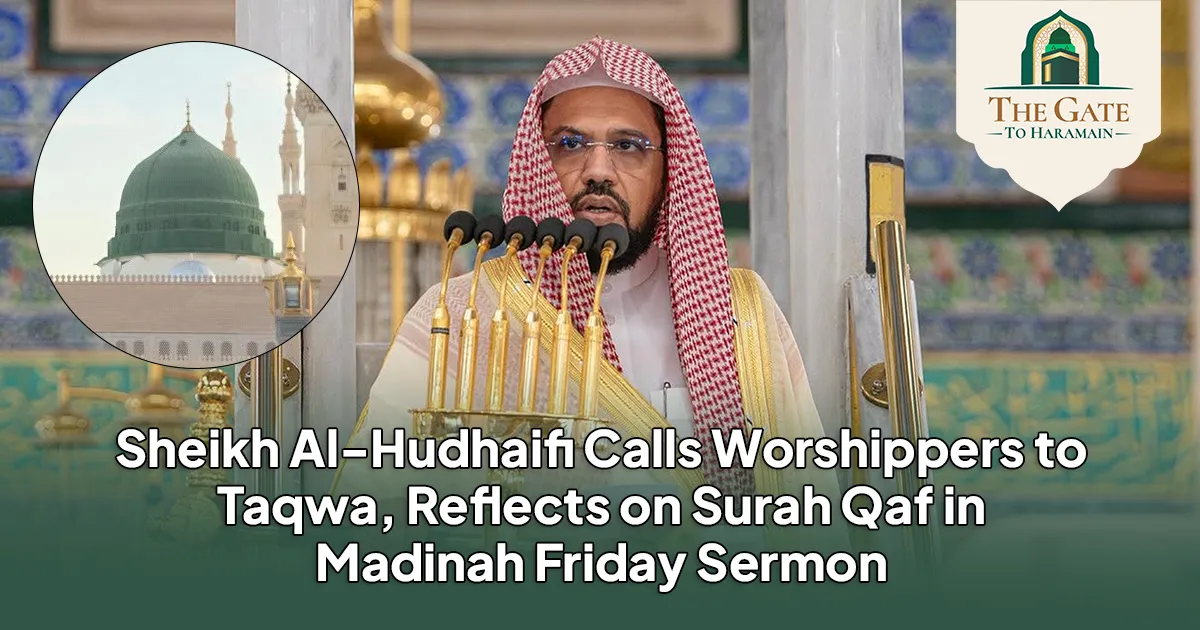
MADINAH—His Eminence Sheikh Dr. Ahmed bin Ali Al-Hudhaifi, Imam and preacher of the Prophet’s Mosque, delivered the Friday sermon and led the prayer on 5 Jumada al-Awwal 1448 AH, corresponding to 16 October 2026.
He urged worshippers to fear God, calling taqwa the best thing a person can keep hidden, the most beautiful thing they can show, and the most precious thing they can store up. The sheikh opened with the traditional Khutbat al-Hajah and cited verses on piety from Surah Ali ‘Imran, Surah An-Nisa, and Surah Al-Ahzab. He quoted the Qur’anic verse “Indeed, the most noble of you in the sight of Allah is the most righteous of you” (49:13). He said the Qur’an holds rulings that satisfy the mind, comfort the soul, and heal the heart, and that it traces the human journey from non-existence, through creation and worldly life, to death, resurrection, reckoning, and final destiny.
Surah Qaf on the Pulpit
The main theme of the sermon was Surah Qaf. The sheikh noted that the Prophet ﷺ often recited it, or parts of it, in his Friday sermons. He cited the narration of Umm Hisham bint Haritha ibn al-Nu’man, who said she learned Surah Qaf from the Messenger of God, who recited it every Friday from the pulpit.
The sheikh said the surah combines clear proofs with warnings that stir hearts and bring tears. It begins with a disconnected letter and a great oath, then turns to the central subject of resurrection. To make the case, it points to the sky, the earth, the mountains, and rain that brings gardens and grain to dead land. “Thus is the resurrection,” the sheikh quoted.
The surah then turns to history, recalling the peoples of Noah, the companions of the well, Thamud, ‘Ad, Pharaoh, the people of Lot, the companions of the thicket, and the people of Tubba’, who rejected their messengers. The sheikh cited the verse “And We have already created man and know what his soul whispers to him” (50:16) and the verse “And how many a people We destroyed before them” (50:36). He said these show God’s complete knowledge of human beings and his power over them.
Belief in the Afterlife
The sheikh said belief in God and the Last Day is central to a believer’s life. It brings peace of mind amid the turmoil and rapid change of this world. A believer who keeps God in mind, honors God’s rights and the rights of others, and sees this world as a stage on the way to God finds calm in the middle of life’s troubles.
He quoted the closing advice of the surah: “So be patient over what they say and exalt [Allah] with praise of your Lord before the rising of the sun and before its setting” (50:39). He then recited the command to remind those who fear God’s warning with the Quran.
Sanctity of the Two Holy Cities
The sheikh said Makkah and Madinah hold a high rank with God, His Messenger, and believers throughout history. He noted that Islamic law forbids hunting wild game and cutting trees within the sacred boundaries so that all living creatures are safe there.
Condemnation of Houthi Attacks
The sheikh condemned the Houthi group for targeting Makkah and Madinah and for an attack on King Khalid International Airport in Riyadh. He said the attacks killed innocent people, terrorised civilians, and harmed visitors and pilgrims. He called them crimes condemned by Islamic law, sound reason, natural human disposition, and international law.
He compared these attacks to the People of the Elephant, whose plot failed when God sent birds against them, as recounted in Surah Al-Fil. He said such aggressors are recorded in history as oppressors and corrupters.
Prayers for the Kingdom
In his closing supplications, the sheikh asked God to protect Saudi Arabia, “the cradle of revelation” and the resting place of the Prophet ﷺ, from the plots of enemies. He prayed for the Custodian of the Two Holy Mosques, King Salman bin Abdulaziz, and his Crown Prince, Mohammed bin Salman, and for their success in serving the people and the country. He also prayed for the armed forces, for the security of the borders, for religious scholars, and for Muslims everywhere.
Congregational Prayer
After the sermon, the Imam led the two-unit Friday prayer. In the first rak’ah, he recited Surah Al-Kafirun, and in the second, Surah An-Nasr.