
How to Control Your Tongue – Prophet’s Mosque Friday Sermon 9 Oct 2026 (28 Rabi ul Akhir 1448 AH)
Think back to the last conversation that went sideways. Maybe someone cut you off in traffic, left a dismissive comment under your post, or dropped an unfair critique during a team meeting. What was your initial impulse? For most of us, the instinct is swift, sharp, and defensive. We want to snap back, settle the score, or deliver a stinging comeback that leaves no doubt about who won the exchange.
Winning an argument with a biting insult is a hollow victory. The quick satisfaction fades within minutes, leaving behind lingering tension, damaged trust, and unnecessary regret. The harsh phrase you blurt out in ten seconds can poison a friendship, fracture a family tie, or derail a professional partnership built over years.
Many people dismiss spoken words as harmless vapor. We tell ourselves that words vanish the second sound waves disperse. Yet human history, modern cognitive science, and timeless spiritual wisdom show the opposite. The phrases you utter do not vanish. They linger in memory, mold your habits, alter your emotional state, and shape your character.
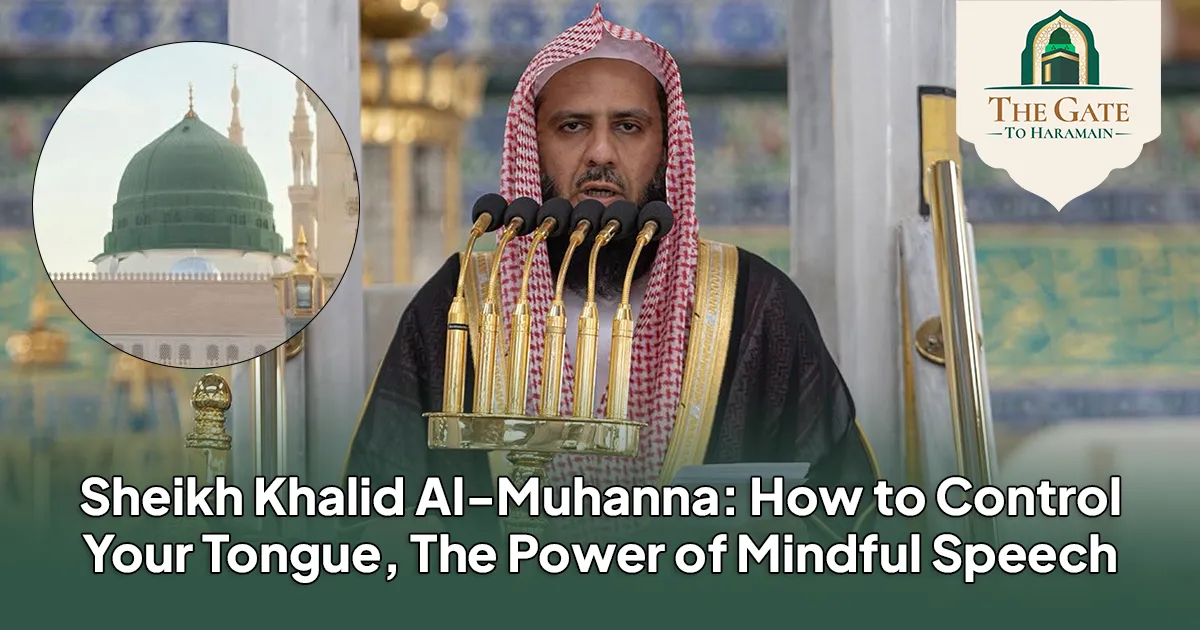
On Friday, October 9, 2026, Sheikh Dr. Khalid Al-Muhanna addressed this precise challenge from the pulpit of the Prophet’s Mosque in Medina. Addressing thousands gathered for the Friday sermon, he reminded the assembly that consciousness of God is the finest quality one can conceal, the most beautiful attribute one can show, and the most precious asset one can store up for the future. At the very heart of that spiritual foundation sits a disciplined tongue.
Learning how to control your tongue is one of the hardest personal habits to develop, but it yields enormous dividends for your mental clarity, personal integrity, and peace of mind.
The Illusion of Harmless Talk
A widespread misconception in modern life is that speech does not count as actual behavior. You would never sign a terrible financial contract without reading the terms, nor would you throw a physical punch at a coworker during a disagreement. You instinctively treat physical deeds with caution because their consequences are obvious and immediate.
When it comes to spoken statements, people drop their guard. They treat verbal barbs, unverified rumors, and petty complaints as throwaway moments. During his address at the Prophet’s Mosque, Sheikh Dr. Khalid Al-Muhanna warned against this casual attitude, noting that people frequently forget that every syllable uttered forms part of their permanent record.
History echoes this exact reality. The eighth-century leader Umar ibn Abd al-Aziz observed that whoever does not count speech as part of their concrete actions will make endless errors. Another respected scholar of that era, Abu Amr al-Awza’i, pointed out that whoever understands that words are recorded deeds speaks far less.
Treating conversation as consequence-free leads directly to verbal recklessness. People prize quick wit, caustic sarcasm, and unedited transparency, mistaking fast fluency for wisdom. Quick fluency without self-restraint is a liability. An undisciplined tongue can cause more serious, longer-lasting damage than physical injury.
A careless word inflames conflict, while a measured response defuses hostile situations before they spiral out of hand. If you want to build emotional maturity, you have to treat every sentence as a real, irreversible action.
Linguistic Framing: How Your Words Mold Your Mind
The vocabulary you use does far more than broadcast your thoughts to others; it loops back and actively conditions your inner state.
In his sermon in Medina, Sheikh Dr. Khalid Al-Muhanna drew attention to an instructive historical example recorded in classical traditions of the Prophet Muhammad. He advised his followers never to say, “My soul has become vile,” but instead to say, “My soul has become sluggish”.
The distinguished scholar Ibn al-Qayyim analyzed this exact distinction centuries later. On a surface level, both statements point toward the same physical or emotional reality: a person feels fatigued, low on enthusiasm, or temporarily out of sorts. The Prophet rejected the first phrasing because of its moral ugliness. Calling your spirit vile injects moral decay into your identity, transforming a temporary dip in energy into an intrinsic character flaw. Calling yourself sluggish accurately describes a transient physical condition without poisoning your self-worth.
Modern cognitive behavioral research confirms this psycholinguistic reality. The specific labels you attach to your feelings dictate how your brain processes stress:
- If you tell yourself, “My whole day is ruined, and everyone is against me,” your nervous system reacts to catastrophe.
- If you frame the same moment as, “I have hit an annoying obstacle, but I can work through it,” your prefrontal cortex remains engaged, allowing you to solve problems calmly.
The Prophet consistently modeled this linguistic discipline. As Sheikh Dr. Khalid Al-Muhanna explained, historical accounts describe him as someone who chose gentle expressions whenever possible, avoiding abusive speech, loud shouting, and vulgar remarks. He actively replaced names and labels that carried bleak, ugly connotations with names that reflected optimism, purity, and clarity.
When you clean up your daily vocabulary, you are not merely engaging in polite etiquette. You are actively pruning negative mental pathways and cultivating an interior life rooted in stability.
Words as Social Healing: Speech as Charity
Kindness is often viewed purely through a financial lens. Society equates giving with writing checks, donating goods, or funding public initiatives. While material support is indispensable, it leaves out a huge portion of human suffering. A person can have a full stomach and a comfortable home while enduring profound loneliness, grief, or emotional isolation.
Spiritual tradition offers a radical equalization: a kind, sincere word is an act of charity.
This teaching strips away the economic barrier to doing good. You do not need wealth to lift someone’s spirit. As the preacher emphasized at the Prophet’s Mosque, offering an earnest greeting of peace, explaining a helpful concept, or comforting someone through a difficult hour provides genuine emotional sustenance.
Words can heal what money cannot reach. When someone asks you for support, and you lack the resources to assist them, offering a gracious apology, an encouraging wish, and sincere respect is far better than offering material aid tainted by arrogance or condescension. Ancient scriptures explicitly declare that kind words and gracious forbearance are superior to gifts trailed by insults.
Imagine a manager named Sarah. One of her team members, David, makes a public calculation error that delays a project delivery. A typical manager might vent irritation by declaring, “This is sloppy work, and you need to pay attention.”
Sarah pauses. She knows that humiliation shuts down learning and breeds quiet resentment. Instead, she pulls David aside and says, “This delay is frustrating for both of us, but I know how hard you worked on this phase. Let us review the numbers together, correct the mistake, and set up a safeguard for next time.”
Sarah did not ignore the problem, nor did she lower her standards. She chose a measured, constructive framing. David leaves the conversation motivated to repair the mistake rather than paralyzed by shame. Sarah’s choice of language preserved David’s dignity, protected team morale, and resolved the issue faster. That is the practical power of disciplined speech.
De-escalating Conflict: Defeating the Provocation Cycle
Discord rarely begins with a massive ideological divide. It almost always begins with a careless slight, an uncharitable assumption, or a dismissive tone.
Classical wisdom warns that hostility feeds on poor dialogue. When tension surfaces, raw pride urges you to attack the other person’s motives, match their venom, and widen the rift.
In the Medina Friday sermon, the Imam pointed out that believers are divinely commanded to select the finest, most constructive phrasing because hostility feeds on friction. A single well-timed, peaceful statement can extinguish a burning dispute, while a defensive barb pours gasoline on the blaze.
Consider a documented historical incident involving Sulaiman ibn Surad. Two men were trading furious insults in front of the Prophet Muhammad until one man’s face flushed red and his veins swelled with unchecked rage. Seeing this physical reaction, the Prophet stated that he knew a statement that would make the man’s fury vanish if he spoke it: seeking refuge with the Creator from the influence of evil impulses.
That intervention targets the cognitive break required during heated arguments. Anger triggers an automatic, primitive fight-or-flight response. Your heart rate accelerates, your field of vision narrows, and you lose access to thoughtful reasoning.
Breaking that biological loop requires an intentional pause. Inserting a deliberate phrase, taking a slow breath, or reciting a grounding remembrance pulls the brain out of reactive mode. It creates the mental space needed to choose a measured response over a destructive outburst.
Four Practical Steps to Master Your Tongue
Mastering speech is not an abstract theory. It requires daily, deliberate practice. Here are four practical habits you can implement to build verbal discipline:
1. Weigh Words Before Speaking
Before responding in any conversation, run your thoughts through a simple mental screen:
- Is this statement true?
- Is it necessary to say right now?
- Is it framed in a respectful way?
If your comment fails any of these tests, stay silent. Surah Qaf in the Quran reminds believers that every single word uttered is accounted for by an attentive observer. Keeping that truth in mind curbs the urge to make reckless remarks.
2. Stop Repeating Everything You Hear
One of the fastest ways to destroy trust and spread division is unverified repetition. The venerable eighth-century jurist Imam Malik stated that it is a mark of profound corruption for an individual to repeat everything they hear.
Rumors, unverified social media claims, and workplace gossip thrive because people pass information along without verifying its accuracy. Make it an unbending rule never to repeat a story or critical claim unless you have seen direct evidence and speaking about it serves a constructive, necessary purpose.
3. Replace Silence with Wholesome Words
The human mind dislikes a complete vacuum. If you try to control your speech purely through willpower and suppression, you will eventually slip up. A mouth forced into bitter silence eventually boils over into complaints, cutting remarks, or gossip.
The classical remedy shared in the Prophet’s Mosque is active replacement. Fill your verbal capacity with positive, purposeful expressions. In the spiritual tradition, this means keeping the tongue accustomed to the remembrance of God, expressing gratitude, offering supplications, and sharing useful knowledge. If you train your tongue to utter constructive, peaceful statements throughout the day, malicious speech finds no room to take root.
4. Practice the Twenty-Second Anger Rule
When you feel anger rising, your jugular veins tightening, or your pulse racing, impose a strict twenty-second verbal moratorium.
Do not type a reply. Do not utter a syllable. Consciously take a deep breath and redirect your focus toward a grounding statement of peace. Allow the initial adrenaline surge to subside before you formulate an answer. When you finally speak, address the issue directly without attacking the person.
The Foundations of Lasting Character
In the Quranic parable from Surah Ibrahim, wholesome speech is compared to a noble tree. Its roots are anchored deep within solid earth, and its branches reach upward toward the sky, continually yielding sweet, nourishing fruit. By contrast, foul speech is like a corrupt weed scraped from the surface of the soil, unstable, bitter, and producing nothing of lasting value.
Your speech reveals the true state of your character. You cannot cultivate a peaceful, dignified life while allowing your tongue to produce cruelty, arrogance, and discord. The two cannot exist together. A heart that values goodness naturally produces words that bring relief, clarity, and reconciliation to others.
Take an honest look at your conversational habits over the past week. Did your words bring comfort to troubled minds, or did they create unnecessary friction? Did you share useful knowledge, or did you pass along hollow gossip?
Commit to one specific change starting right now: during your next difficult conversation, pause, withhold the sharp comeback, and choose the most constructive response available. Speak words that heal rather than harm, because the sentences you utter today become the legacy you leave behind tomorrow.