
High Ambition Isn’t a Luxury, It’s a Duty: Masjid al-Haram Friday Sermon 25 September 2026 (14 Rabi ul Akhir 1448 AH)
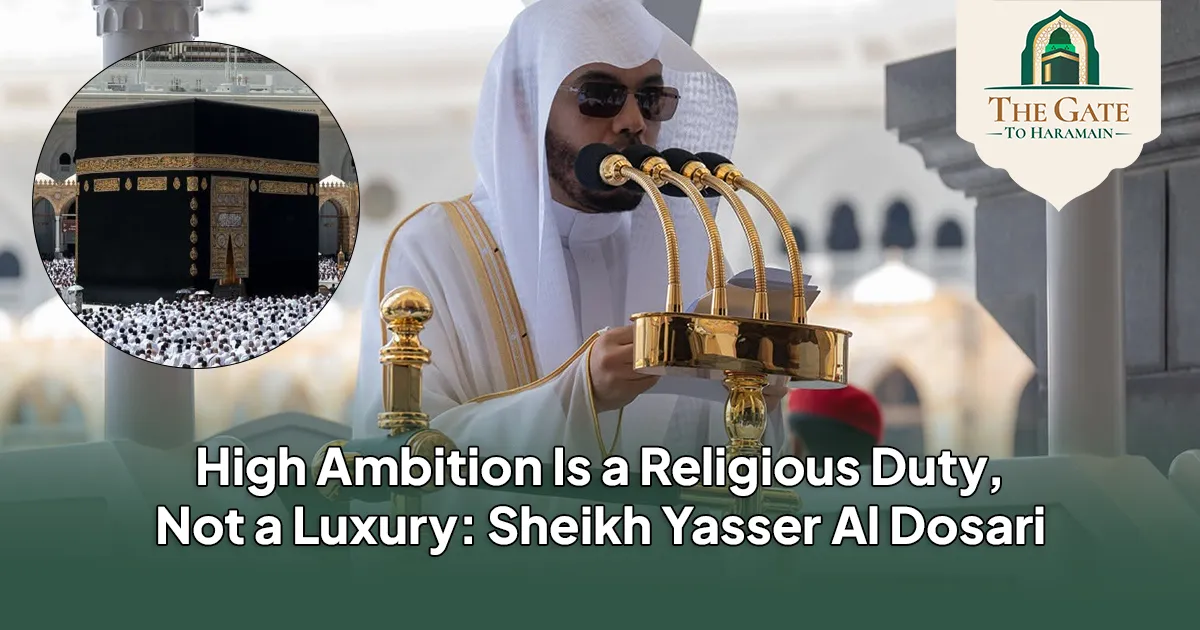
Some sermons tell you to slow down. This one told people to speed up.
In this week’s Friday sermon at the Masjid Al Haram in Makkah, Sheikh Dr. Yasser Al-Dosari built his entire khutbah around one idea: uluww al-himmah, or high resolve. Not motivation-poster ambition. Something closer to a religious obligation — the refusal to settle, dressed up as a virtue with roots in scripture, not self-help.
The Case Against Settling
Sheikh Yasser Al-Dosari opened with a claim that’s easy to nod along to and harder to actually live by: among the noblest qualities a person can have is high ambition, because it’s what separates them from helplessness and humiliation. He called it “the secret of success” and “the ladder to ascend to the highest peaks” — in this life and the next.
That’s the whole sermon in one line, really. Everything after it is scaffolding.
He grounded the idea in text, not sentiment. The Quran’s instruction to “race to do good deeds” isn’t a suggestion to keep pace — it’s a command to compete. A hadith has the Prophet telling a companion that when you ask God for something, ask for Paradise itself, not a lesser reward. And in a hadith attributed to Al-Tabarani, God is described as loving “noble, high matters” and disliking the trivial and petty. Low expectations, in other words, aren’t humility. They’re a failure of nerve.
The Prophet as the Proof of Concept
Every sermon needs an example, and Al-Dosari didn’t reach far for his. The Prophet Muhammad, he said, was the clearest model of high resolve there is — someone who carried the weight of his mission with patience until it changed hearts across the world. His companions followed the same pattern: they gave up wealth and comfort for something bigger than themselves, and the generations after them kept the standard alive.
The line that stuck with me: it is “unbefitting for a person of faith to settle for mediocrity or accept anything less than the stars.” Not a metaphor about hard work. A statement about what faith is supposed to demand of you.
Ibn al-Qayyim’s Test for Ambition
The sermon’s sharpest moment came from a quote, not from Al-Dosari himself. Citing the classical scholar Ibn al-Qayyim, he offered a definition of high resolve that’s less about achievement and more about attachment: true ambition means you don’t stop short of God or attach yourself to anything beside Him. The sign of fallen ambition, by contrast, is contentment with lowly things — feeling at ease with what’s trivial.
It’s a strange, almost clinical way to think about ambition. Not “did you achieve enough,” but “did you settle for too little, and did that settling feel comfortable.” The second part is the trap. Comfort with mediocrity doesn’t usually announce itself.
Time Is the Actual Currency
Al-Dosari then did what most sermons on ambition eventually do: he turned to time. Life is short, he said, and what’s already passed doesn’t come back — echoing the Quranic line, “Did you think that We created you in vain?”
From there he cited a well-known hadith, the “Five Before Five,” which is really a checklist disguised as poetry:
- Your youth, before your old age
- Your health, before your sickness
- Your wealth, before your poverty
- Your free time, before you’re too busy
- Your life, before your death
He named procrastination and false hope as the two things standing between a person and actually living by that list — and told the congregation to choose their company deliberately, because ambition, like laziness, tends to be contagious.
Ambition Isn’t an Exit From the World
Here’s where the sermon made its most useful correction. High resolve, Al-Dosari said, doesn’t mean abandoning the world or retreating from it. It’s not asceticism. It’s an inner strength that pushes a person toward excellence in both religion and worldly life — citing the Quranic instruction to seek the Hereafter through what God has given you, without forgetting your share of this world.
He pointed to Saudi Arabia’s Vision 2030 as his real-world case study: a nation, in his framing, pursuing ambition without abandoning its principles. His summary of that balance was tighter than anything else in the sermon: authenticity doesn’t mean isolation, modernity doesn’t mean losing yourself, and real leadership is doing both at once.
Loyalty as Worship, Not Slogan
The second sermon shifted from personal ambition to national duty, and made an argument that’s easy to miss if you’re not listening closely: loyalty to a homeland isn’t rhetoric. Al-Dosari listed nine concrete expressions of it — doing your work well, keeping your commitments, respecting the law, protecting shared resources, strengthening social unity, rejecting extremism, staying alert to destructive ideologies, and pushing back on rumors and disinformation.
He was direct about current events, condemning attacks targeting Saudi Arabia and its holy sites — including Mecca and Medina — as grave transgressions. His closing formulation folded citizenship straight into theology: safeguarding the homeland is a matter of religion, defending it is an act of worship, unity is a fortress, and agreement of word is protection.
The sermon closed with supplications — for Muslims worldwide, for the sick and the indebted, for Palestinians and the preservation of Al-Aqsa Mosque, and for the country’s leadership and security forces — followed by prayer recitations from Surah Al-Hajj and Surah Al-Fath, both centered on safe, secure access to the Sacred Mosque.