
Moderation Is Not Standing Still: Masjid Al Haram Friday Sermon 20 Nov 2026 (10 Jumada al-Akhirah 1448 AH)
Most of us think of balance as a 50/50 split. Half the day for this, half for that. Today’s Friday sermon at the Grand Mosque in Makkah says that picture is wrong.
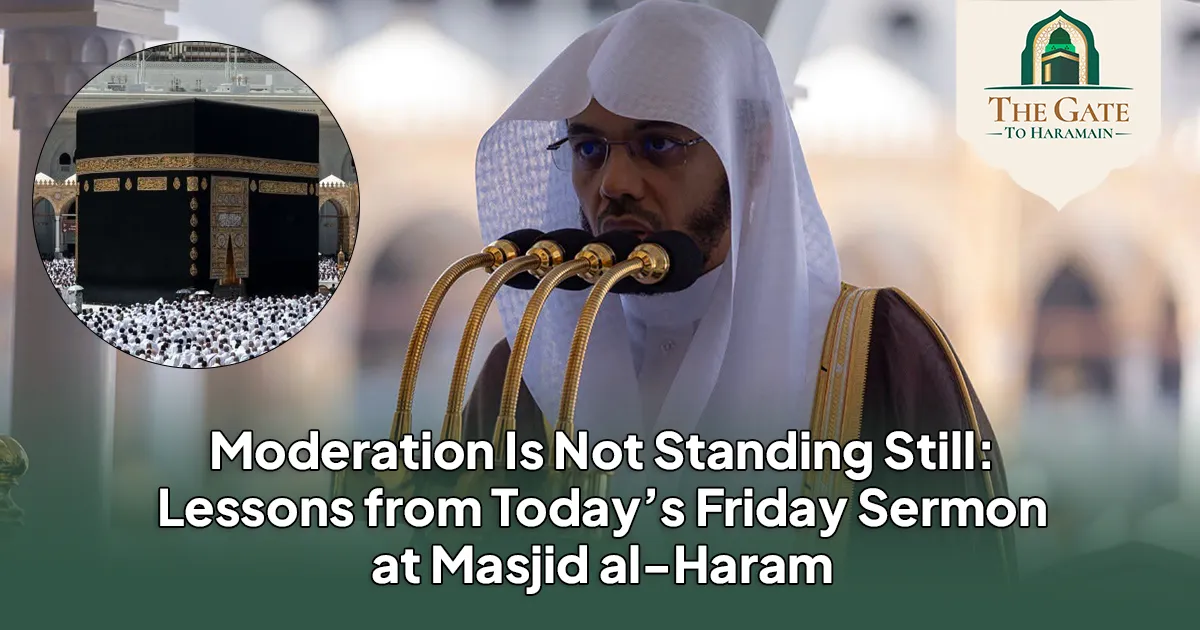
The sermon and prayer were led by Sheikh Dr. Yasser bin Rashid Al-Dosari on 10 Jumada al-Akhirah 1448 AH (20 November 2026). His subject was moderation, or wasatiyyah, the middle path. He argued that moderation is not a mood or a lifestyle tip. It is part of how God built the world.
A universe built on balance
The Sheikh began with taqwa, advising worshippers to fear God. He then tied moderation to creation itself. God, he said, set up the universe on a precise and wondrous balance, and the divine law follows the same pattern.
He pointed to the verse “He created everything and determined it with precise determination” (Surah Al-Furqan 25:2). He also cited “We have sent Our messengers with clear proofs and sent down with them the Scripture and the balance” (Surah Al-Hadid 57:25). And he cited “And thus We have made you a median community” (Surah Al-Baqarah 2:143).
He reminded the congregation that the Arabic word al-wasat carries the meaning of justice and fairness. So the middle path is not a lukewarm compromise. It is what fairness looks like in practice.
Balance is not an equal split
This was the most striking part of the sermon. Moderation, the Sheikh said, is not just organizing your time, spreading your effort, or dividing things equally between unequal rights. It is fiqh al-awlawiyyat, the understanding of priorities. It means knowing which right comes first and weighing benefit against harm.
He gave a clear order:
- Obligatory duties come before voluntary acts.
- Necessities come before needs.
- The most important comes before the merely important.
- Consequences must be weighed too.
Priorities should be judged by the scale of the Sharia, he said, and not by habit or whim. Think about that the next time you wonder why a packed schedule still leaves you feeling off. It may not be a time problem. It may be a priority problem.
Three rights, one person
The Sheikh grounded this in a well-known account from Sahih al-Bukhari. Salman al-Farsi told Abu al-Darda: “Your Lord has a right over you, your soul has a right over you, and your family has a right over you, so give each their due.” The Prophet ﷺ confirmed it: “Salman has spoken the truth.”
The sermon drew a practical lesson from it. Extra worship becomes a problem when it costs a person their health, their marriage or their children’s upbringing. God’s right comes first, and it is met through sincere worship and following the Sunnah. But the body and soul need care together, and a family needs attention, upbringing, and provision. Neglect one and the whole structure wobbles.
He also described the Prophet ﷺ as the best example: the most devoted to his Lord, the most generous to his family, and the most beneficial to people.
The ship does not drop anchor
In the second sermon, the Sheikh used an image that many listeners will remember. A person in this life is like a ship on a rough sea. It does not stay in harbour for fear of the waves. It keeps its course, steady and determined.
That changes what moderation means. It is not stagnation or rigidity. It is movement with direction, and it avoids both reckless rushing and hesitation that ends in stumbling. He added that moderation is acquired. It is built through knowledge, effort, and patience, and it marks maturity.
Balance in ordinary life
The Sheikh then moved from principle to daily practice. He described the pairs we all have to hold together:
- Seriousness and rest: avoid burnout on one side and laziness on the other.
- Reason and emotion: thinking without compassion is cold, and feeling without wisdom is unstable.
- Idealism and realism: dreams must respect limits, but realism should not turn into surrender.
- Ambition and contentment: ambition without contentment becomes greed, and contentment without ambition becomes idleness.
- Spending: he quoted “neither excessive nor sparing, but between that, justly balanced” (Surah Al-Furqan 25:67).
- Time: learn from the past, work in the present, and hope for the future.
- Parenting and relationships: firmness softened by mercy, and mercy disciplined by firmness.
- Trust and accountability: trust alone breeds neglect, while accountability alone breeds suspicion.
Each pair works the same way. Take away one half, and the other turns into a fault.
Tradition, modernity, and the news you share
The Sheikh also spoke about holding firmly to principles while understanding the modern world. The answer, he said, is to stay anchored to established scholars, which protects the mind from extremist currents and misguided groups.
He asked listeners to judge people and positions by verified facts, not slogans. Do not believe or share everything that circulates, he said. Check the news and go back to reliable official sources, especially on matters of security and public safety.
On community, he spoke of unity of ranks, putting public interest above private interest, and avoiding both division and fanaticism. He also noted the Kingdom’s long-standing concern for the Muslim world and its holy sites, with Al-Aqsa Mosque first among them.
Closing du’a and the prayer
The sermon ended with blessings on the Prophet ﷺ, his family, and his companions. It included prayers for Islam and Muslims, for the leadership of the Kingdom, for the armed forces and security personnel, for the sick, the indebted, and the grieving, and for relief for the oppressed, with a special mention of the people of Palestine.
In the Friday prayer that followed, the Imam recited Surah Al-A’la in the first rak’ah and Surah Al-Ghashiyah in the second. Both speak of God’s creation, reflection, and the lasting value of the Hereafter, which fits the sermon’s theme closely.
One takeaway
If you take away one thing, make it this: balance is not about doing less of everything. It is about giving each right its proper place and then moving forward with purpose. This week, pick one area where your priorities are out of order and fix that first.