Delaying Hajj? Read What Mufti Taqi Usmani Says About It
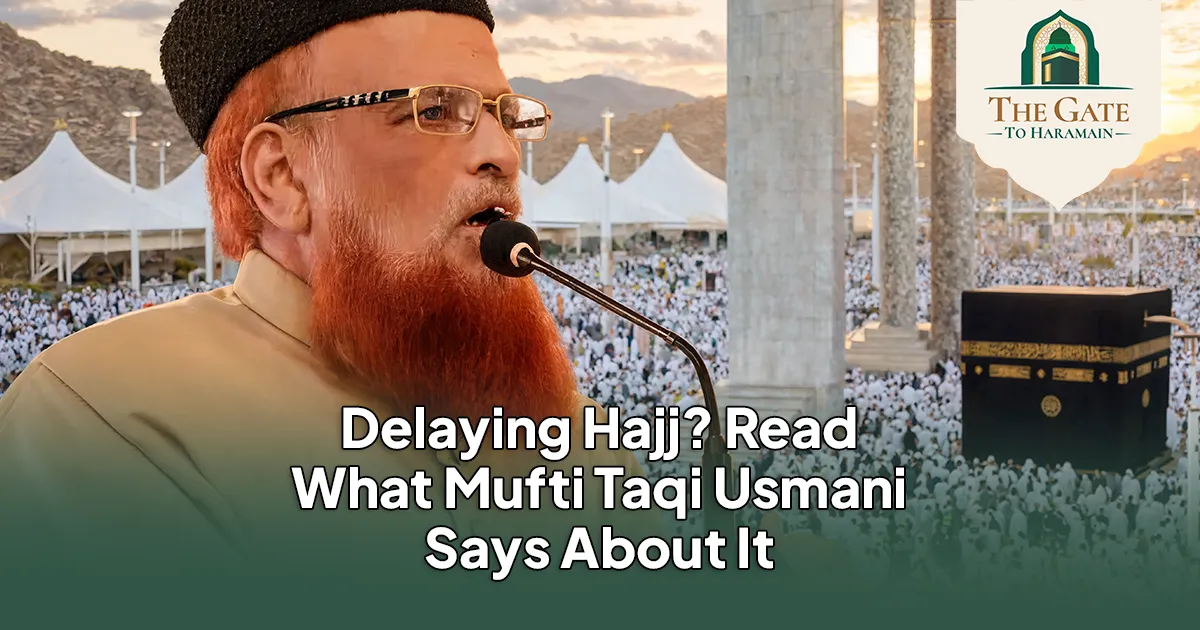
Most of us know at least one person who talks about Hajj the way they talk about retirement from the job. A something for later.. Once the kids are settled and life has calmed down. Mufti Taqi Usmani addressed exactly this attitude in a recent bayan, and he did not soften it.
He called it a misconception that has taken root in our society, and he was blunt about the sin involved in putting off Hajj without a real excuse.
“I will go once my children are married”
Mufti Sahab described a pattern we clearly see often: someone becomes eligible for Hajj, it turns fard on them, and instead of going, they wait. Sons and daughters need to be married off first, these people often reason. Hajj can come after, and only if there’s money left over.
Mufti Taqi Usmani did not accept this logic. He said that arranging a child’s marriage is good, but spending heavily on it is not required of anyone. Sharia does not set a price tag on a wedding. So, using a self-imposed expense, one you chose to take on, as the reason to delay an actual obligation does not really hold together.
The dowry problem
A good part of this bayan was given to dowry, or jahez, and the pressure it puts on a bride’s family. Mufti Taqi Usmani described how common it has become for the groom’s side to expect the bride to arrive with dowry, and how families who cannot provide it are often taunted for it. He called this one of the worst customs in our society and said it has to end.
His solution was simple, at least in principle: the groom’s family should say upfront that they want the bride, not jewellery, not dowry, nothing beyond her. He touched on some of the harm this custom causes and said he’d take it up in more detail another time, God willing.
A walima does not need to cost 10 lakhs.
The same reasoning carries over to the walima. It’s a sunnah, Mufti Sahab confirmed, but nothing about it demands a big hall or an expensive spread. A simple meal for eight or ten people, costing a few hundred rupees, fulfils the sunnah just as completely as a banquet does.
He pointed to how simply the Prophet ﷺ once observed his own walima, a mat spread out, whatever food people had brought was gathered on it, and that was the meal: no grand expense, no elaborate arrangement. Spending large sums on a walima, Mufti Sahab said, is not something the deen has ever asked of anyone.
Putting off an obligation for something that isn’t one
This is where the bayan lands its main point. Postponing an obligatory Hajj so you can first pay for a costly wedding, an elaborate walima, or dowry, none of which Sharia requires, isn’t something Islam permits. “Once the daughters are married,” or “once the sons are settled,” is not a valid religious excuse to keep delaying Hajj. Mufti Sahab was clear: doing so is a sin.
He then brought up a hadith carrying a severe warning. If Hajj has become fard on someone, and they have no genuine excuse, not sick, have the means to travel, nothing and no one stopping them, no government restriction in their way, and they still don’t go, the hadith states: let such a person die, if he wishes, as a Jew or a Christian.
Mufti Sahab was careful to explain what this doesn’t mean: it isn’t saying the person actually leaves Islam. The Prophet ﷺ chose the strongest language available to make one thing clear: neglecting an obligatory Hajj is a serious matter, comparable in its indifference to the kind of rejection associated with those who deny the obligation outright.
He tied this to a verse from Surah Aal-e-Imran: “And whoever disbelieves [i.e., refuses] — then indeed, Allah is free from need of the worlds” (3:97). Allah doesn’t need your Hajj, Mufti Sahab said, or your Umrah. Whatever benefit comes from it is entirely yours. But once the obligation is on you, arranging for it without further delay becomes your job, not something to schedule around.
Also read: Pakistan Launches Online Hajj Payment System as 2027 Registrations Top 150,000
“No one gave you a guarantee”
One more excuse came up: living on rent, wanting to build a house first, planning to go for Hajj only once that’s done. Mufti Taqi Usmani’s answer to this was pointed. No one, he said, has handed you a signed guarantee that you will live to see your children married, or live long enough to finish building that house. If death arrives first, and Hajj was never performed despite being obligatory, the same warning stands.
The bottom line
Once Hajj becomes fard, Mufti Taqi Usmani’s position leaves little room for interpretation: it isn’t something to slot in after weddings, dowry, a walima, or a house. None of those carries the weight of an obligation the way Hajj does. Treating them as prerequisites is, in his words, a flawed idea that has spread through our society and one that people need to unlearn.