Lying About a Dream Is Lying Against Allah: Masjid ul Haram Friday Sermon 14 August 2026 (1 Rabi’ al-Awwal 1448 AH)
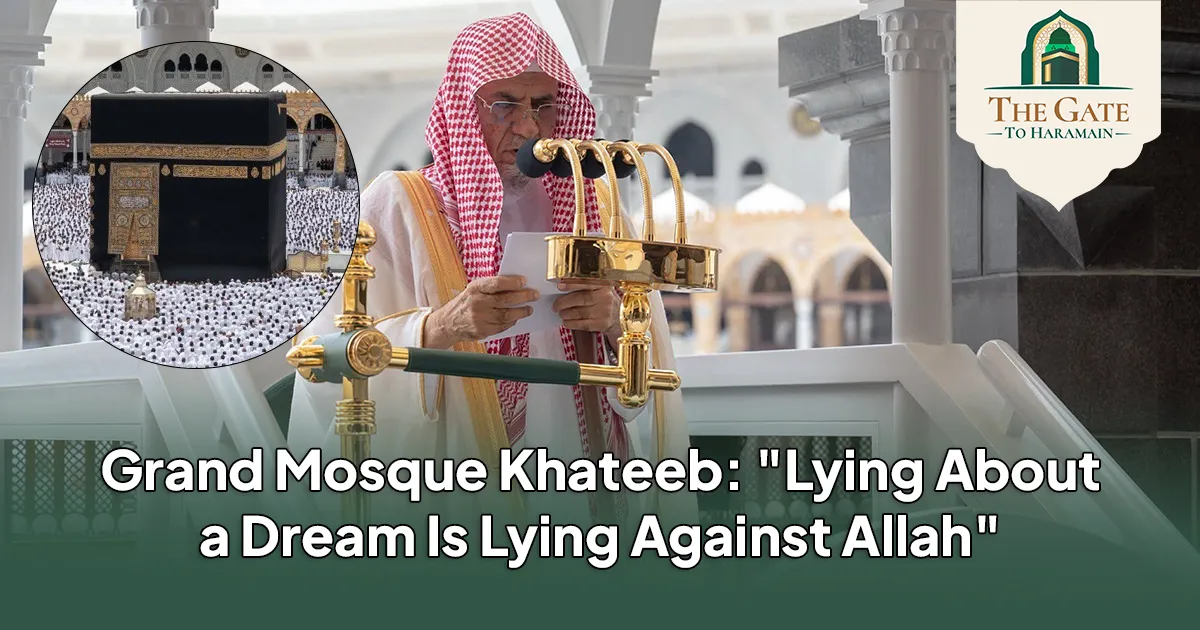
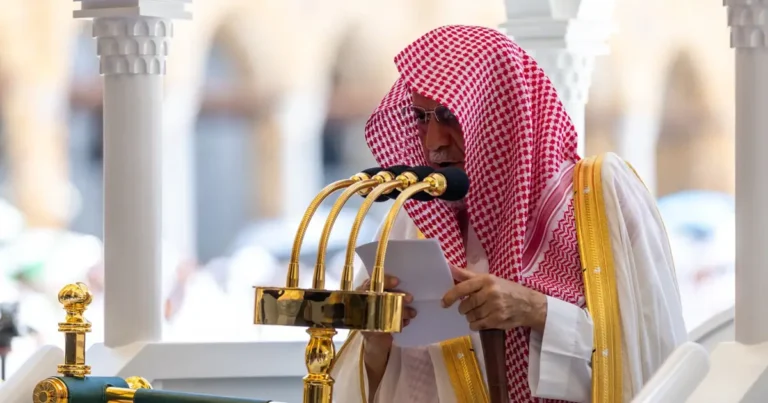
Sheikh Dr. Saleh bin Abdullah Al-Humaid, Imam and Khateeb of the Grand Mosque, delivered this Friday’s khutbah in Makkah, 1 Rabi al-Awwal 1448 AH, corresponding to August 14, 2026.
Before the sermon turned to dreams, it started somewhere quieter: the inner self. Real strength, the sheikh said, doesn’t announce itself. It sits in Taqwa, that constant, private awareness of Allah, and in a mind disciplined enough to govern the tongue rather than be governed by it. Silence, used well, does more work than a reactive word ever could.
That discipline carries a responsibility most of us don’t think about often enough: making sure our presence in other people’s lives is a source of safety, not stress. The Prophet ﷺ put it bluntly:
“The worst person in status before Allah on the Day of Resurrection is the one whom people leave to avoid his evil.”
Once that groundwork was laid, restrain the ego, master the character, the khutbah moved into its real subject: our fascination with the unseen, and where a believer is and isn’t allowed to go looking for it.
Chasing the Unseen Through the Wrong Door
Wanting to know what’s coming is human. Everyone feels it. But the sheikh was clear that trying to force open that door through horoscopes, geomancy, or fortune-telling isn’t a shortcut; it’s a trap dressed up as certainty. It feels like control. It costs a person their clarity and, eventually, their faith.
He pointed to a hadith warning that consulting and believing such sources amounts to rejecting what Allah has already revealed to humanity. Al-Tahawi’s point sharpened it further: someone who goes chasing what’s forbidden to them, refusing to submit to divine wisdom, ends up with their own vision clouded rather than clarified. Believing a fortune-teller isn’t a harmless curiosity; it chips away at the integrity of pure monotheism itself.
Which raised the natural question: if the occult is off-limits, is there any legitimate window into the unseen at all? The sermon’s answer was yes, and it’s been sitting in plain sight the whole time.
Why the Prophet ﷺ Took Dreams Seriously
Righteous dreams, the sheikh explained, aren’t superstition. They’re described as one of the forty-six parts of Prophecy, Al-Mubashshirat, glad tidings, the one remnant of the prophetic gift that continued after the Prophet’s ﷺ passing.
He walked through how seriously the scholars have treated this:
- Al-Nawawi noted that the Prophet ﷺ routinely asked his companions about their dreams not out of idle interest, but to teach them how interpretation actually works and to draw out whatever news of the unseen the dream carried.
- Ibn Hajar read that same habit as proof of how much weight dreams deserve, and how much skill their interpretation demands.
- Ibn al-Qayyim called dreams “symbolic parables.” He’s the one who explained why interpretation is called Ta’bir, literally “crossing,” because the interpreter crosses from the symbol on the surface to the meaning underneath.
- Ibn Sa’di placed dream interpretation within Islamic jurisprudence altogether, treating it as a kind of fatwa.
- Ibn Abd al-Barr went further still, calling belief in truthful visions a duty they carry, in his words, “wonders of Divine wisdom” that strengthen a believer’s faith.
That last point is the hinge the rest of the sermon turns on: if dream interpretation is a form of fatwa, it isn’t something to hand over to whoever happens to have an opinion. It needs knowledge, piety, and real grounding, the same as any other religious ruling.
Three Kinds of Dreams, and Why the Difference Matters
To keep people from spiraling over every strange dream, the sermon laid out three categories, and each one comes with its own response.
Good dreams (الرؤية الصالحة). These are glad tidings, meant to reassure rather than unsettle. The sheikh tied their accuracy directly to how a person lives while awake, citing the Prophet ﷺ:
“The most truthful of people in speech during wakefulness are the most truthful in dreams.”
Honesty, halal earnings, and consistent remembrance of Allah are what make a dream trustworthy in the first place. When one of these comes, the guidance is simple: thank Allah for it, and only share it with someone loved, wise, or capable of giving sincere, constructive counsel, not with just anyone.
Distressing dreams (الحلم). These are Satan’s attempts to plant fear or grief. The Prophet ﷺ gave a five-step response for them:
- Seek refuge in Allah from Satan and the evil of the dream.
- Spit dryly over the left shoulder, three times.
- Get up and pray.
- Change the side you were sleeping on.
- Tell no one about it.
Self-talk (حديث النفس). Also called Adghath Ahlam: muddled dreams. These are just the mind processing the day: work stress, family worries, whatever’s been on your plate. No prophetic weight to them at all. The advice here is almost a relief — let them go.
Interpretation Is Human Effort, Not Absolute Truth
Here’s where the sermon added an important check on itself. Even a dream that clearly matters still has to be interpreted, and interpretation is Ijtihad, human reasoning, which means it can be wrong.
The example the sheikh gave was Abu Bakr (RA), interpreting a dream in front of the Prophet ﷺ himself. The Prophet’s ﷺ response: he was right about some of it, and wrong about the rest.
If the most trusted of the companions could get part of an interpretation wrong, that’s a warning against anyone treating their own reading of a dream, or someone else’s, as final. An interpreter needs honesty, real knowledge, and sound character. Going to someone who lacks those isn’t a small risk; it invites confusion and, worse, spiritual harm.
A Dream Can’t Rewrite the Law
The sermon then drew a hard line: dreams, however meaningful, have no authority over Shari’ah. They can’t make something permissible that wasn’t, and they can’t create new religious obligations. Revelation ended with the Prophet’s ﷺ death, and nothing since has reopened that door.
Al-Nawawi’s example made it concrete: if someone dreams that the Prophet ﷺ tells them tomorrow is the first of Ramadan, but the moon hasn’t actually been sighted, the dream doesn’t override the legal requirement. The law stands regardless of what the dream said.
Lying About a Dream Is Lying About Allah
The sermon’s most sobering section dealt with fabrication. Claiming a vision you never had isn’t a small exaggeration; it’s a major sin, and the punishment described for it is deliberately impossible to carry out: on the Day of Judgment, the person will be tasked with tying a knot between two grains of barley, or, in another version, two hairs. A task designed to never be finished, matching a lie that can never be undone.
Al-Tabari’s explanation is what makes the severity click: fabricating a dream is really a lie against Allah, because the person is claiming Allah showed them something He didn’t. It’s not just dishonesty toward other people — it’s a direct betrayal of the trust a believer owes.
Closing: Dua for the Ummah
The khutbah closed the way Friday sermons at the Grand Mosque often do, turning outward, toward the wider community. The congregation prayed for:
- The security and stability of Muslim nations, the protection of their borders, and guidance for their leaders, the Custodian of the Two Holy Mosques and the Crown Prince, toward what benefits the people.
- The protection and victory of the people of Palestine, and the preservation of Al-Aqsa Mosque’s sanctity.
- The restraint of those working against peace, and for the tide to turn against them.
The sermon’s real thread, start to finish, was this: dreams can open a window into something real, but a believer’s footing stays in the waking world, in Taqwa, honesty, and how we actually live. As the closing dua put it, we ask Allah for a sound heart and a vision that’s true.
Coverage of Friday sermons from Masjid al-Haram and Masjid an-Nabawi, from The Gate To Haramain.