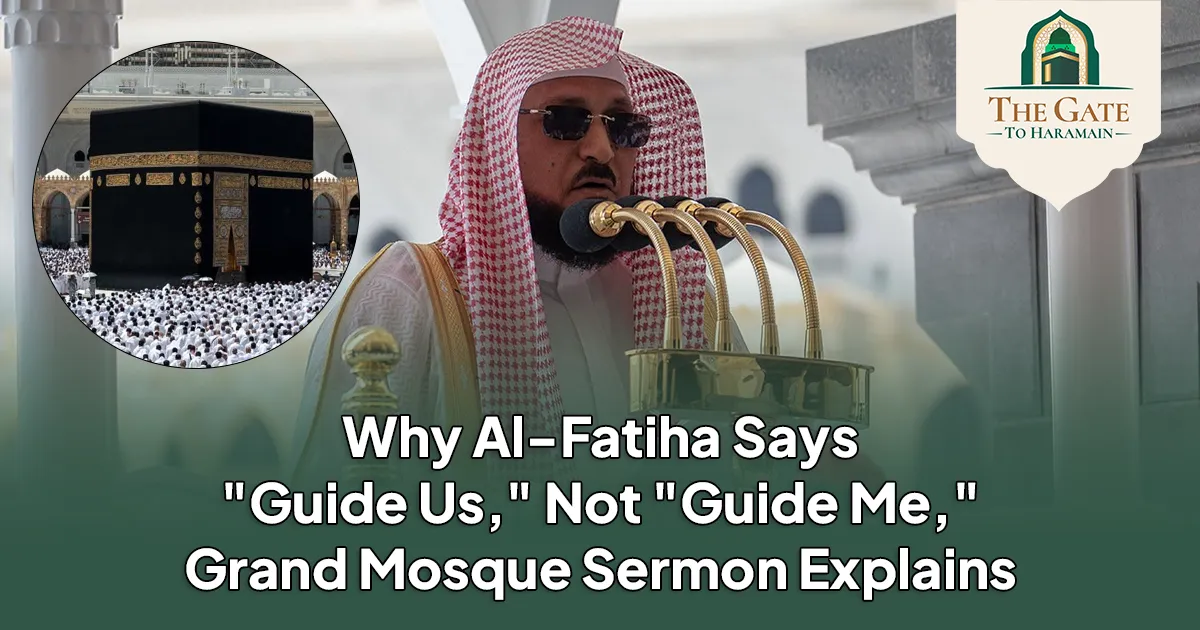
Why Al-Fatiha Says “Guide Us” Not “Guide Me” – Masjid al-Haram Friday Sermon 11 September 2026 (29 Rabi al-Awwal 1448 AH)
“Whoever fears his Lord is saved and succeeds; whoever follows his desires strays and is ruined.”
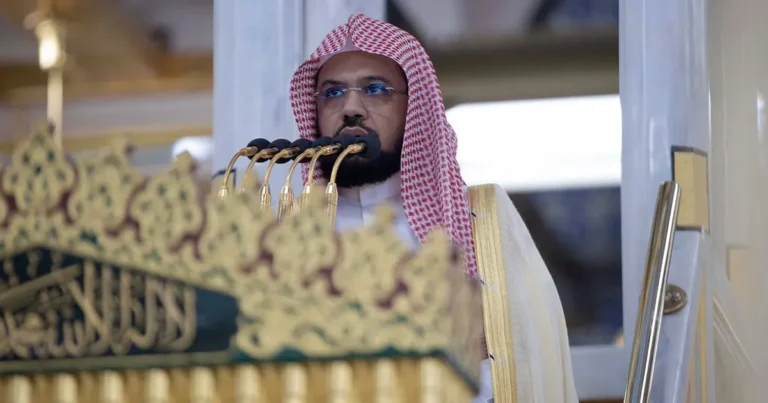
With these words, the Imam and Khateeb of the Masjid Al Haram in Makkah, Sheikh Dr. Maher bin Hamad Al-Muaiqly, opened this week’s Friday sermon at Masjid al-Haram in Makkah. What followed was a full unpacking of one concept every Muslim recites daily but rarely stops to examine: Al-Sirat Al-Mustaqim, the Straight Path.
Why We Ask for Guidance in Every Raka’ah
Every Muslim repeats “اهدنا الصراط المستقيم” — “Guide us to the Straight Path” — in Surah Al-Fatiha, in every single raka’ah of every prayer. Sheikh Al-Muaiqly explained why this plea never gets retired once you are “guided enough.” Guidance works in two directions: the one who has strayed asks to be returned to the path, and the one already on it asks for thabat — firmness, so the path doesn’t slip away beneath them.
The path itself has a clear definition. It is the religion of Islam. The Quran is its map, and the Sunnah of the Prophet ﷺ is what makes the map legible. Walking it puts a person in the company of the Prophets, the Truthful, the Martyrs, and the Righteous — not a metaphorical company, but the literal one named in scripture.
The Two Pillars That Keep You on It
Sheikh Maher said that the steadfastness rests on two pillars. First, Tawheed — worshipping Allah alone, with no partners, echoing the Quranic instruction: “And worship Me; this is a straight path.” Second, Ittiba’ — following the Prophet’s ﷺ exact model, not an adapted or convenient version of it.
Miss either pillar and the trajectory bends. Directing worship anywhere but Allah, or worshipping Allah through bida’ — religious innovation with no basis in the Sunnah — both count as veering off, regardless of how sincere the intention feels.
A Line in the Sand
To make the abstract concrete, the sheikh returned to a narration recorded in Musnad Ahmad by Ibn Mas’ud (may Allah be pleased with him). The Prophet ﷺ once drew a single straight line in the sand: “This is the path of Allah.” Then he drew smaller lines branching off it, left and right: “These are paths; on every path there is a devil calling toward it.” He then recited the verse that gives the image its meaning:
“And this is My path, straight, so follow it; and do not follow other paths, for they will scatter you away from His path…” (Al-An’am: 153)
The Bridge You’re Already Building
This is where the Friday Khutbah’s most striking connection lands. Just as Allah laid out a Straight Path in this life, He will erect a physical bridge — Al-Sirat — over Hellfire on the Day of Resurrection. Citing the Hadith of Intercession in Sahih Muslim (narrated by Abu Hurairah, may Allah be pleased with him), Kaaba Imam Sheikh Maher described the scene: Amanah (trust) and Rahim (family ties) stand as witnesses on either side of the bridge, and people cross it at speeds that mirror how they lived — some like lightning, some like the wind or birds or fast runners, others crawling. Along the sides, iron hooks seize those whose worldly choices earned it. Through it all, the Prophet ﷺ stands at the edge, pleading: “رب سلم سلم” — “My Lord, save! Save!”
The classical scholar Ibn al-Qayyim (may Allah have mercy on him) put the connection plainly: a person’s speed and firmness crossing the Sirat in the next life is an exact reflection of their speed and firmness on the Straight Path in this one. Whoever was steady here will be steady there. Whoever was caught by the hooks of desire, doubt, and misguided innovation here will be caught by the hooks there too.
Why the Surah Al Fatiha Says “Us,” Not “Me”
There is a detail in Surah Al-Fatiha easy to recite past without noticing: “Ihdina” — “Guide us” — is plural, not singular. Sheikh Maher Al-Muaiqly drew out what that grammar is doing. Islam does not let guidance be a private transaction between an individual and Allah; you ask for your own steadiness while asking for your community’s in the same breath. Truth unites; personal whims and innovation divide.
That principle scales up into the methodology of Ahl al-Sunnah wal-Jamat: hold to the Quran and Sunnah, keep the unity of the Muslim community, obey legitimate leadership in what is good, and stay wary of extremism in religion. The sheikh pointed to Saudi Arabia’s founding on the Quran, Sunnah, and unity of word as a blessing that obligates ongoing gratitude, not a one-time historical fact but a standing responsibility.
Steadfastness Doesn’t Mean Sinlessness
Here the Friday sermon offered its most reassuring turn. Istiqamah: steadfastness. It was never meant to require ‘Ismah, infallibility. The Prophet ﷺ said the best of those who make mistakes are those who repent. Fall short, and the instruction is immediate correction. Wrong someone, and the instruction is to restore what’s owed. Get overtaken by sin, and the instruction is sincere tawbah. This is precisely why Allah pairs the two commands in one verse: “So take a straight course to Him and seek His forgiveness” (Fussilat: 6). Forgiveness-seeking is not a fallback for when steadfastness fails — it’s built into what steadfastness means.
Closing Supplications
The sermon closed with prayers for peace and security across Muslim lands, for the Kingdom’s leadership and security forces. He also prayed for the people of Palestine and the protection of Al-Aqsa Mosque. The congregation then stood for Friday Salah, the Imam calling the rows to order — “Istawu, istawu, taqarabu, wa suddu al-khalal” — before leading Surah Al-Fatiha with Surah Ad-Duha in the first raka’ah and Surah Al-Kawthar in the second.
The Takeaway
Strip away the theology for a moment, and the Friday Sermon leaves one practical instruction: the way you move through today and how you handle a promise, a family obligation, a moment of temptation is not separate from the Day of Judgment. It is a preview of it. The bridge does not test a different version of you; it tests the one built by today’s choices. And the built-in safety net is not perfection; it’s catching yourself and turning back.