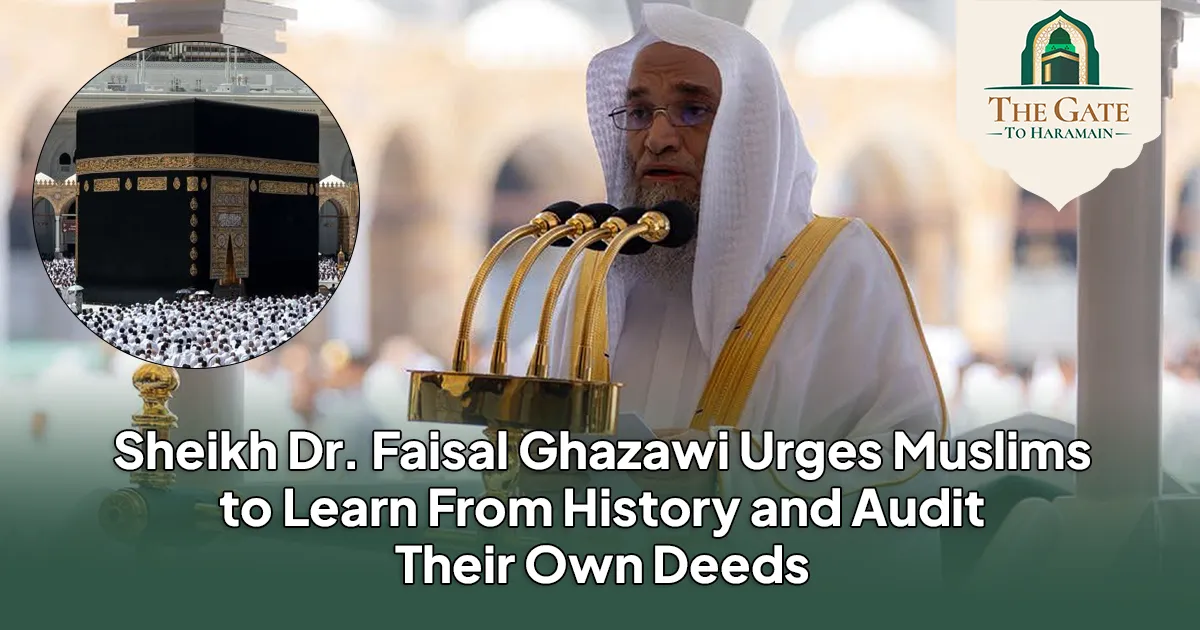
Sheikh Faisal Ghazawi Urges Muslims to Learn From History and Audit Their Own Deeds: Masjid Al Haram Friday Sermon 2 Oct 2026 (21 Rabi ul Akhir 1448 AH)
Masjid Al Haram Friday Sermon 2 Oct 2026
The Imam and Khateeb of the Grand Mosque told worshippers that taking heed of past nations is a shield against falling into the same mistakes.
Makkah Al-Mukarramah, Friday, 21 Rabi’ al-Thani 1448 AH (2 October 2026)
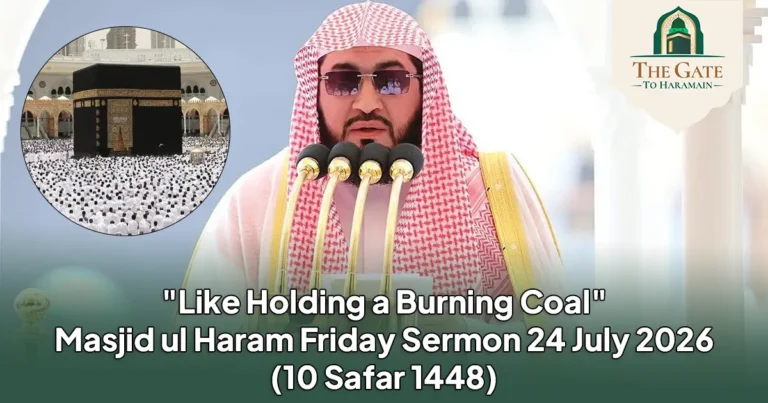
His Eminence Sheikh Dr. Faisal bin Jamil Ghazawi, Imam and Khateeb of the Grand Mosque, delivered today’s Friday sermon in Makkah and led the congregational prayer. He advised Muslims to fear God Almighty, to look hard at what they have done, and to hold themselves accountable before the Day of Reckoning.
Humans are made weak, and error is part of that
The sermon opened with praise of Allah, who shaped humanity in harmony, gave people sight and hearing, and set night and day in turn as signs for reflection and gratitude. Sheikh Ghazawi then reminded the congregation of taqwa (God-consciousness) and turned to human nature.
“Know that we are created with weakness, and we are inherently prone to error,” he said. Desire, lust and anger, when they take over, make evil deeds look appealing and blind a person’s vision, he explained. The ego leads people astray and shortens their sight.
He reminded worshippers that people are made of clay. “We are not perfect, nor are we infallible,” he said.
The failure, he said, is not in the slip. “It is not shameful to slip and stumble, but it is shameful to remain mired in error while looking on, persisting in it without repentance.” A believer, he added, rises with unwavering resolve whenever he slips on a steep path. He cited the Prophet’s saying that a believer is not stung from the same hole twice, and said every Muslim should be alert, prudent and ready to learn from past mistakes.
Taking heed from earlier nations
The central theme was i’ti’bar, the duty to reflect on history and take warning from those who crossed the limits set by Allah.
“God has called upon us to learn from the fate of others who disobeyed and transgressed the limits set by our Lord,” the Imam said. When people consider what befell earlier transgressors because of their evil deeds, he said, they should be wary of repeating those deeds and suffering the same punishment.
Sheikh Ghazawi explained that Allah relates many stories in the Quran for a reason. They are there so people can draw lessons, morals and admonitions from them.
He cited several verses and examples:
- Reflection through reason and sight. The Quran urges people to travel and reflect: “Have they not traveled through the land and have hearts by which to reason and ears by which to hear? For indeed, it is not eyes that are blinded, but blinded are the hearts which are within the breasts.”
- Banu al-Nadir. When fear was cast into their hearts, they ruined their own homes with their own hands and the hands of the believers. The Quran’s instruction follows: “So take warning, O people of vision.”
- The Sabbath breakers. Those who transgressed regarding the Sabbath were made a deterrent example and an enduring admonition for the God-fearing (Muttaqin).
- The stories of the prophets. These were not sent down for entertainment. They came to firm the heart of the Prophet Muhammad ﷺ and guide believers. In the words of the Quran: “There was certainly in their stories a lesson for those of understanding.”
The Imam also listed the great historical signs:
- Noah’s Ark, kept as a lasting reminder for attentive ears
- The ruined towns of the People of Lot, left as a clear sign for those who use reason
- The empty, destroyed dwellings of ‘Aad and Thamud, standing as visible proof of divine justice
The People of the Elephant
Sheikh Ghazawi gave particular attention to the Companions of the Elephant (Ashab al-Fil), who were struck with severe punishment when they set out to violate Allah’s sacred limits. God destroyed them, thwarted their efforts and made their plot against the Kaaba and the Sacred House come to nothing. They had meant to disable and demolish it.
He lamented the heedlessness of those who do not learn despite so many warnings, verses and parables. Many people witness trials year after year and still fail to repent or remember, he said. Their state matches the Quranic description of people who see how Allah dealt with earlier transgressors and remain unchanged.
A framework for self-accounting
The Imam said a wise person learns from everything he hears and sees. He should copy the virtues of the righteous and stay away from the conduct of wicked aggressors.
He also set out a practical method of muhasabah (self-examination) for one’s words and deeds:
- If an action is praiseworthy, continue it and follow it with something similar.
- If it is blameworthy, put it right where possible and do not repeat it.
- If you are ignorant, ask.
- If you slip, return.
- If you do wrong, repent.
- If you repent, desist completely.
Quoting the prophetic tradition, he reminded worshippers that every believing servant has a sin he commits from time to time. The believer, the hadith says, was created tried, frequently repenting and forgetful, and remembers when he is reminded.
From this he drew the maxim that taking heed protects against stumbling (al-i’tibar wiqayatun min al-‘ithar). He also quoted several classical sayings:
- “He whose reflection increases, his stumbling decreases.”
- “He who perceives the slip of another secures his own path, and he who considers consequences remains safe from calamities.”
- “He who does not learn from others will become a lesson for others.”
- “The fortunate person is he who takes warning from [the fate of] others.”
He also quoted the classic warning of Hasan al-Basri: “O son of Adam, you are but days; whenever a day passes, part of you passes. So take a lesson from those before you, and do not become a lesson for those after you.”
The second sermon: a list of modern warning signs
In the second sermon, Sheikh Ghazawi moved from ancient history to present-day pitfalls. He repeated one question throughout: is there anyone who will take heed from those who…
- Commit shirk and grave worship. These are people who fail to appreciate Allah’s true greatness and direct worship to others. They call upon the dead, seek the aid of saints, sacrifice and make vows to them, and prostrate before shrines and the occupants of graves. They also attribute to them what belongs to God alone: harm and benefit, giving and withholding.
- Fall into religious extremism (ghuluw). They follow the path of extremist deviants, declare Muslims disbelievers without proof, and label others as sinful or heretical without evidence. They unjustly shed blood and seize property.
- Practise aggression and tyranny. They betray trusts, attack Muslim lands, terrorise peaceful civilians and spill sacred blood.
- Spread doubt and skepticism. They are misled by intellectual ambiguity, attack the firm constants of Islam (muhkamat), and plunge their faith into darkness and suspicion.
- Abandon faith in the name of “liberation”. They follow their desires, discard religious teachings, and call Islam and its followers backward or stagnant.
- Turn to sorcery and charlatans. They visit sorcerers, fortune-tellers and practitioners of magic to harm fellow Muslims.
- Slander and defame. They lie against Allah, spread fabrications, hunt for the flaws of righteous people, and attack the honour of Muslims, living and dead.
- Invent religious innovations (bida’). They introduce practices that neither Allah nor His Messenger ﷺ authorised.
- Neglect prayer. They abandon or disregard the central pillar of Islam and cut their connection with Allah.
- Disobey parents and sever family ties. This covers ‘uquq and qat’ al-rahim.
- Act on impulse and rumour. They rush into decisions such as divorce, judge people on suspicion, or pass on unverified news.
- Corrupt their finances. Some are misers who withhold obligatory rights. Others gain unlawful wealth through fraud and deception.
- Reject sincere advice. They are driven by self-conceit and stubbornness.
The Imam closed this section with a solemn warning. Each of these people faces consequences matching the nature of their own sin, and becomes a lesson for those who reflect.
Supplications for the Muslim world
The Imam sent prayers and blessings upon Prophet Muhammad ﷺ and made a series of supplications. He asked Allah to:
- Protect the Holy Mosques. He asked for the safety of Makkah and Madinah, and for the Kingdom of Saudi Arabia to be blessed with security and prosperity.
- Safeguard Muslim countries. He prayed that they be spared harm, division and warfare.
- Relieve the oppressed. He prayed for the vulnerable, for the defenders on the borders, and for the oppressed in Palestine and around the world.
- Guide the leadership. He asked that the Custodian of the Two Holy Mosques and the Crown Prince be guided toward righteousness and piety.
The Friday prayer
The congregational prayer followed the sermon, with two recitations:
- First rak’ah: Surah Al-A’la (Surah 87), which calls for glorifying the Most High Lord, purification, and preferring the Hereafter over worldly life.
- Second rak’ah: Surah Al-Ghashiyah (Surah 88), which contrasts the humbled people of Hellfire with the joyful dwellers of Paradise. It ends with a call to look at creation: the camel, the sky, the mountains and the earth.
Key takeaways from the sermon
- Slipping is human. Staying down is the failure. The sermon sets no impossible standard of perfection. It says a fall is expected and the real fault is refusing to get up.
- Learn from others, or become the lesson. In the words of Hasan al-Basri, a person’s days are limited, and each one decides whether he takes warning or becomes a warning.
- The Quran’s stories are working tools. The Ark, Lot’s towns, ‘Aad, Thamud, Banu al-Nadir and the People of the Elephant are presented as ways to judge present conduct.
- The second sermon covers a wide range. Grave worship and extremism sit beside rash divorce, rumours, cutting family ties and fault-finding, and the sermon treats all of them as warning signs.