The Heart Is the Measure: Uprightness and Veneration of Allah’s Commands—Masjid Al Haram Friday Sermon 30 Oct 2026 (19 Jumada al-Awwal 1448 AH)
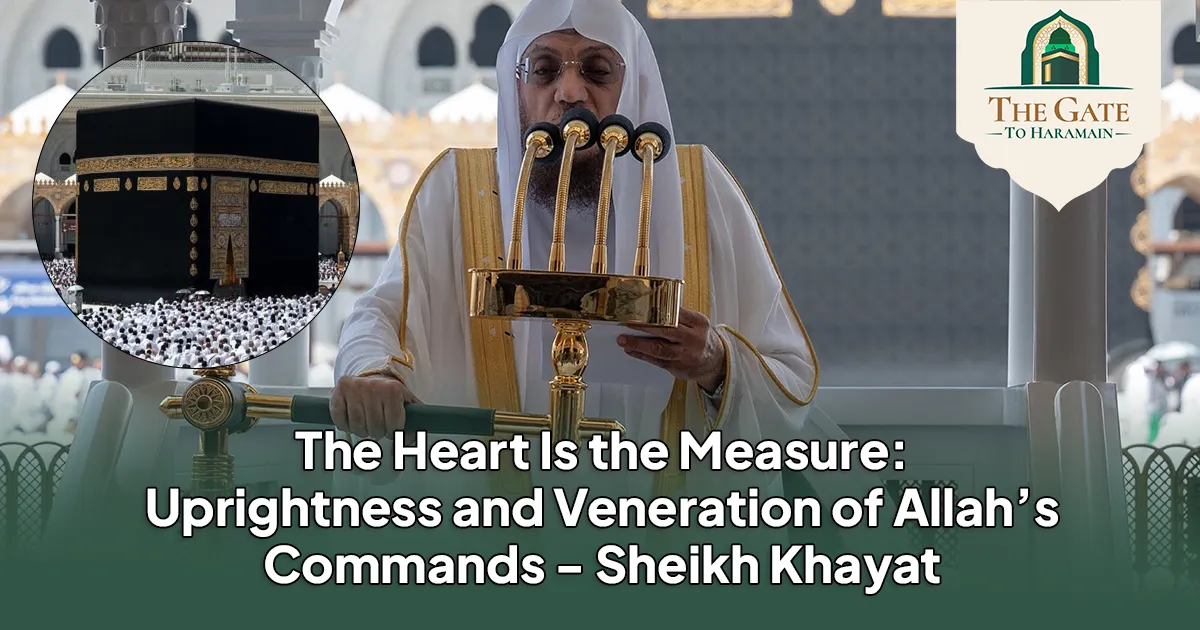
On Friday, 19 Jumada al-Ula 1448 AH, Sheikh Dr. Osama bin Abdullah Khayyat, Imam and preacher of Masjid al-Haram, asked the congregation to fear Allah, turn back to Him in repentance, be sincere in their devotion, and worship Him well. He did not begin with rules or rulings. He began with the body, and then moved to the heart.
Every organ has a perfection
The sheikh explained that Allah has given each organ of the body a perfection that gives it life, strength, and purpose. The eye is perfected by seeing. The ear is perfected by hearing. The tongue is perfected by speech. When an organ lacks its perfection, the soul feels lonely, its vitality fades, and its joy dims in proportion to what is missing.
The heart, he said, holds a special place. The Prophet ﷺ described it in a well-known hadith recorded by Al-Bukhari and Muslim: when the heart is sound, the whole body is sound, and when it is corrupt, the whole body is corrupt. The sheikh said that this hadith is the clearest answer to the question of where a person’s real health lies.
The heart’s true pleasure
The greatest pleasure in this world, the sheikh said, is knowing Allah and loving Him. He called this the paradise of this life. In the Hereafter, the greatest pleasure is seeing the Lord in Paradise and earning His pleasure. Love and knowledge of Allah are, in his words, the delight of the eyes and the joy of the soul. The heart finds no real peace, success, or life without them.
He warned that a heart empty of the love and knowledge of Allah becomes more corrupt than a body whose soul has departed. Only a heart that is still sound can recognize this, he added. A numb heart does not even notice the wound.
Uprightness of the heart, he explained, is a high station and a clear honor. It belongs only to those who place the love of Allah above every other love. When the two loves collide, the love of Allah must win.
Two pillars of an upright heart
The sheikh laid out two pillars.
The first is to put the love of Allah above all other loves. Here he cited a teaching from the scholar Ibn al-Qayyim, which in substance says that whoever finds comfort in Allah will find that comfort reflected in others, and whoever does not will see his soul torn apart by regret over the world. He also described three laws of attachment.
Whoever loves something other than Allah will be tormented by it. Whoever fears something other than Allah will see that thing given power over them. Whoever busies himself with something other than Allah will find it becomes a source of misfortune. Devotion to Allah, by contrast, brings the calm that a restless heart cannot find anywhere else.
The second pillar is veneration of Allah’s commands and prohibitions, and this veneration grows out of veneration of the One who issues them. The sheikh quoted the words of Prophet Nuh in the Quran: “What is [the matter] with you that you do not attribute dignity to Allah?” (Surah Nuh, 71:13). Careless obedience, he said, is a kind of forgetting.
He then raised a danger that many people overlook. Someone may pray, fast, or avoid sin only to protect his reputation, win praise, or escape embarrassment. Such a person may look righteous, but his actions come from self-interest, not from veneration of Allah. The sheikh said that this kind of compliance fails both conditions for accepted worship: sincerity, meaning doing the act purely for Allah, and conformity to the Sunnah of the Prophet ﷺ.
Four signs in daily worship
In the second sermon, the sheikh described four signs that show a person truly venerates Allah’s commands. The first is punctuality, keeping to the proper times and limits of worship. The second is attention to the essentials, completing the obligations and the sunnahs that accompany them. The third is eagerness, moving quickly to fulfill a duty as soon as its time arrives. The fourth is grief over missed good. A believer feels real sorrow when an opportunity for reward slips away.
He applied these signs to the prayer. A person who misses congregational prayer, which carries a reward twenty-seven times greater than praying alone, should feel regret. The same goes for missing the early steps to the mosque, which raise a person’s rank and erase sins, and missing the first row. He also warned about prayer offered without khushu’, the humble presence of the heart. Such a prayer, he said, is like a body without a soul. The obligation may be legally fulfilled, but its reward shrinks sharply. He cited the hadith recorded by Abu Dawud and al-Nasa’i, which says that a man may finish his prayer and have recorded for him only a tenth of it, or a ninth, or an eighth, all the way up to a half.
Supplications and the Friday prayer
The sermon closed with long supplications from the minbar. The sheikh sent blessings upon the Prophet ﷺ, his family, his wives, his companions, and the four rightly guided caliphs. He prayed for the strength and protection of Islam and Muslims, the unity of their ranks, and just leaders in every nation. He asked Allah to keep Saudi Arabia and all Muslim lands in peace, security, and prosperity, and to guide the Custodian of the Two Holy Mosques and the Crown Prince. He asked for healing and victory for the border guards and security forces. He prayed against hostile and extremist groups, naming the Houthis, and for the liberation of Al-Aqsa Mosque and relief for the Muslims of Palestine. He also asked for forgiveness and goodness in this life and the next.
The Imam then led the Friday prayer. In the first rak’ah, he recited Surah Al-A’la, and in the second, Surah Al-Ghashiyah.
What the sermon leaves with us
The sermon ties the health of a person’s inner life to a single question: what does the heart love most? The sheikh answers that a heart at peace loves Allah first, fears Him above all, and gives His commands the honor they deserve. Outward acts count, but they count fully only when the heart is in them. A prayer with the presence of the heart, an act done for Allah alone, and an obligation fulfilled on time all come from the same source.
The congregation in Makkah heard this message on a Friday when many pilgrims and residents were gathered together. For those reading from far away, the lesson is the same. Check the heart first, then the actions that follow from it.