Unity Begins With Knowing Allah—Sheikh Hudaify: Masjid An Nabawi Friday Sermon 23 Oct 2026 (12 Jumada al-Awwal 1448 AH)
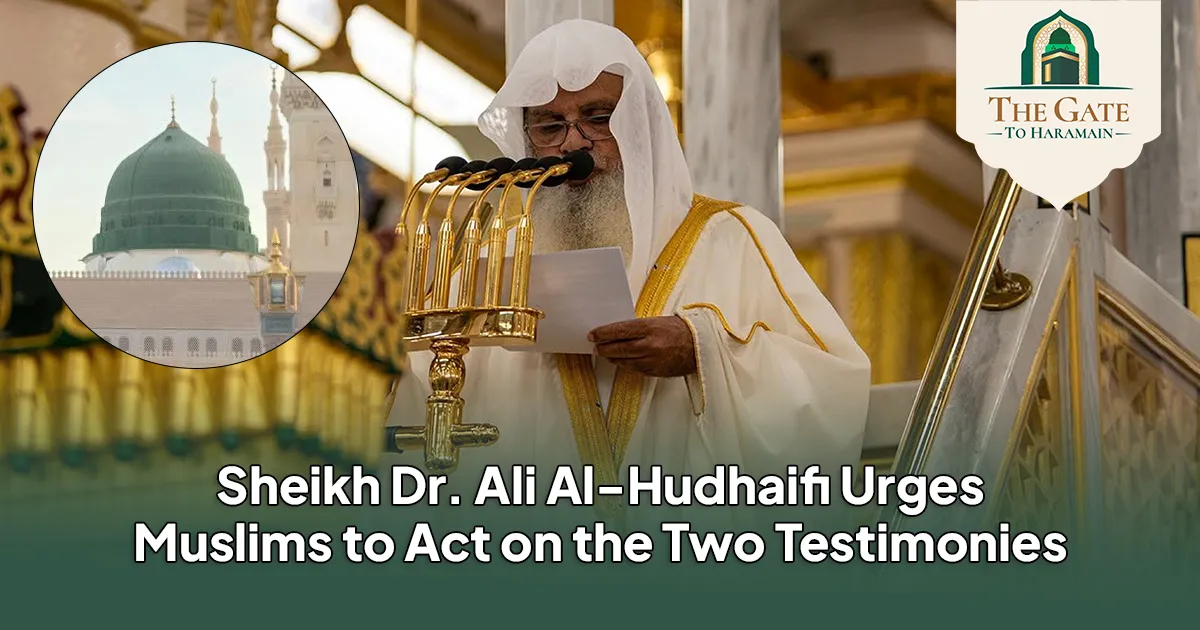
Friday sermon at the Prophet’s Mosque, Madinah, delivered by Sheikh Dr. Ali bin Abdul Rahman Al-Hudhaifi, 12 Jumada al-Ula 1448 AH (23 October 2026)
Sheikh Dr. Ali Al-Hudhaifi opened his sermon by praising Allah, the Sovereign, the Holy, the Mighty, the All-Wise, whose mercy reaches every creature. He then turned to the foundation of the faith: taqwa, or God-consciousness. He defined it as hastening toward good deeds and staying carefully away from what Allah has forbidden.
That duty, he explained, was the message every messenger carried, and it reached its completion in Prophet Muhammad, peace and blessings be upon him. The revelation he brought is a complete guide to every part of human life. The Quran itself says, “And We have sent down to you the Book as a clarification for all things and a guidance and a mercy and good tidings for the Muslims” (An-Nahl, 16:89). Sheikh Dr. Ali Al-Hudhaifi also cited the scholars who taught that Allah left no religious duty unexplained and no worldly matter without guidance.
Sheikh Dr. Ali Al-Hudhaifi’s central theme was the meaning of the two testimonies: that there is no god but Allah, and that Muhammad is the Messenger of Allah. He stressed that these testimonies must be understood with certainty and acted upon in word and deed, and he called on Muslims to be brothers, united and harmonious, just as they are united in uttering them.
The First Command Was Tawhid
Sheikh Dr. Ali Al-Hudhaifi said the first command Allah gave His Messenger was to worship Him alone, and the first prohibition was against shirk, associating partners with Him. He recited the verse that makes this plain: “Say, ‘I have only been commanded to worship Allah and not associate anything with Him. To Him I invite, and to Him is my return'” (Ar-Ra’d, 13:36).
He pointed out that the Prophet’s first act was to introduce people to the Lord of the Worlds and teach them His Most Beautiful Names and Sublime Attributes. Other Quranic verses reinforce the same priority: “Say, ‘I only invoke my Lord and do not associate with Him anyone'” (Al-Jinn, 72:20). The Prophet called people to this with wisdom and good instruction, as the Quran commands: “Invite to the way of your Lord with wisdom and good instruction” (An-Nahl, 16:125).
Sheikh Dr. Ali Al-Hudhaifi argued that real worship cannot exist without knowing Allah’s Names and Attributes. A person who does not know Allah cannot truly worship Him, cannot earn His pleasure, and cannot reach Paradise through ritual alone. Worship built on ignorance of who Allah is does not hold together.
This is why the Shahada, the testimony of faith, stands as the gateway. Sheikh Dr. Ali Al-Hudhaifi took it apart carefully, and that is where the sermon’s teaching becomes practical.
Two Testimonies, Two Obligations
The first part, Lā ilāha illallāh, means there is no deity truly deserving of worship except Allah. Sheikh Dr. Ali Al-Hudhaifi explained that it carries two meanings. It affirms that all worship belongs to Allah alone and denies that anything else deserves it. It also requires that love, fear, hope, reliance, prayer, vows, and supplication all be directed to the Creator.
He described the declaration as a new, upright way of life. It means directing supplication to Allah alone and calling on no one besides Him, not a close angel, not a sent prophet, not a saint, not a grave, not angels, and not jinn. It means that reliance, desire, awe, fear, hope, seeking help, seeking assistance, seeking refuge, and vows are for Allah alone, with no one associated with Him in them.
The second part, Muḥammadun Rasūlullāh, binds the believer to the Prophet. Sheikh Dr. Ali Al-Hudhaifi listed its consequences: obeying his commands, believing everything he conveyed, avoiding what he forbade, and worshipping Allah through his Sunnah, which the Prophet described as having a night like its day. Sincerity pleasing to the Almighty, the Forgiving, is what gives these acts their value.
When Quraish Heard the Single Word
To show what the Shahada means in practice, Sheikh Dr. Ali Al-Hudhaifi recounted a narration from Ibn Abbas, recorded by Imams Ahmad, An-Nasa’i, and At-Tirmidhi. When Abu Talib fell ill, a group of Quraish leaders, including Abu Jahl, came to him. They complained that his nephew insulted their gods and rejected their ancestral worship, and they asked Abu Talib to stop him.
Abu Talib called the Prophet and relayed the complaint. The Prophet replied that he only wanted them to say one word. If they did, the Arabs would submit to them, and the non-Arabs would pay them tribute.
The leaders were delighted and offered to give him ten words in return. The Prophet said, Lā ilāha illallāh.
They rose in fury and shook their clothing. “Has he made the gods into one God? Indeed, this is a curious thing!”
Sheikh Dr. Ali Al-Hudhaifi’s point is that Quraish understood the words perfectly. They saw that the phrase was not a passing statement but a complete way of life. Saying it meant turning away from idols and intercessors and directing every form of supplication, reliance, fear, hope, and vow to Allah alone. The Quran records their arrogance: “Are we to leave our gods for a mad poet?” (As-Saffat, 37:35-36). He noted that this same stubbornness has repeated itself in every age.
The Creed of Ahl al-Sunnah
Sheikh Dr. Ali Al-Hudhaifi then spoke about the creed held by the Companions, the Successors, and the four imams of the schools of jurisprudence: Abu Hanifa, Malik, Shafi’i, and Ahmad ibn Hanbal. He said this belief is the salvation from every innovation, and it is the belief of Islam.
He explained that the people of this creed affirm for Allah His beautiful Names and all His sublime Attributes, both essential and active, affirming their existence and reality. They do not claim to know the nature of these attributes, with certainty that the human mind cannot comprehend their realities.
The creed rests on four principles:
| Principle | Description | Theological Formulation |
|---|---|---|
| Affirmation of Reality (Ithbāt Wujūd wa Ḥaqīqah) | Affirming all divine Names and Attributes (both essential and actional) exactly as stated in revelation. | Affirmation without resemblance (Bila Tamthīl) |
| Negation of Modality (Nafy al-Kayfiyyah) | Affirming that human intellect cannot comprehend the intrinsic “how” or nature of divine attributes. | Exalted above human comprehension |
| Rejection of Distortion (Bila Ta’wīl / Bila Ilḥād) | Refusing figurative reinterpretation, philosophical distortion, or deviation from literal textual reality. | Textual fidelity |
| Transcendence Without Denial (Tanzīh Bila Ta’ṭīl) | Declaring Allah far above creation without denying Him the attributes He has revealed. | “There is nothing like unto Him, and He is the Hearing, the Seeing” (Ash-Shura, 42:11) |
Sheikh Dr. Ali Al-Hudhaifi pointed to a feature of Quranic speech. When the Quran affirms Allah’s attributes, it does so in detail: His knowledge, power, hearing, sight, mercy, and sovereignty. When it negates, it uses short, sweeping statements such as “There is nothing like unto Him.” Ayat al-Kursi and the closing verses of Al-Hashr show this balance clearly.
He also explained that following the Prophet is the first act of putting these two testimonies into practice. Allah says: “Indeed, in the Messenger of God you have an excellent example” (Al-Ahzab, 33:21), and “And indeed, you are of a great moral character” (Al-Qalam, 68:4). Sheikh Dr. Ali Al-Hudhaifi urged Muslims to unite by adhering to the creed of the Prophet and by following the Companions and those who followed them in righteousness, of whom Allah said: “And the first to embrace Islam of the Muhajireen and the Ansar and those who followed them in righteousness” (At-Tawbah, 9:100).
Unity Is Not Optional
Sheikh Dr. Ali Al-Hudhaifi made a direct appeal for solidarity. Agreeing on the Shahada with the tongue, he said, must show up in how Muslims live together. He named four bonds that hold the Ummah together. The first is a shared creed. The second is the Arabic language, in which Muslims worship in their prayers. The third is a shared history of revelation since Allah sent the prophets. The fourth is a shared qiblah, the Kaaba that Prophet Ibrahim built, which Muslims face in prayer.
He called Muslims to unity, strength, and harmony and to reject division and discord. He recalled Allah’s words: “And hold fast, all of you, to the rope of Allah, and do not be divided. And remember the favor of Allah upon you when you were enemies, and He brought your hearts together” (Al Imran, 3:103). Through that favor, he said, the believers became brothers after being on the brink of a pit of fire.
Sheikh Dr. Ali Al-Hudhaifi also stated a principle that history has proven: any calamity or hardship that falls on the Muslims cannot be averted or lifted except through cooperation, mutual support, and compassion. He warned that people with ill intentions see evil in good Islamic legislation and work by every means to distort it, sow doubt, and obstruct good efforts. Still, Allah’s promise stands: “And Allah is predominant over His affair, but most of the people do not know” (Yusuf, 12:21).
The Second Sermon: Brotherhood in Practice
In the second sermon, Sheikh Dr. Ali Al-Hudhaifi spoke about brotherhood and responsibility. Believers are protectors of one another, enjoining good and forbidding evil (At-Tawbah, 9:71-72). He cited the hadith narrated by Al-Nu’man ibn Bashir: “The example of the believers in their mutual affection, mercy, and compassion is like that of a single body: if one limb suffers, the rest of the body responds with sleeplessness and fever.”
He also noted that Islam has faced destructive ideas since its earliest days and that these attempts to dim its light have repeatedly failed against people who hold firmly to authentic teaching.
He concluded by calling for compassion and cooperation among Muslims in righteousness and piety. He described these as the qualities of believing men and women, citing Allah’s words: “The believing men and believing women are allies of one another. They enjoin what is right and forbid what is wrong and establish prayer and give zakah and obey God and His Messenger. Those—God will have mercy upon them. Indeed, God is Exalted in Might and Wise” (At-Tawbah, 9:71). He reminded the congregation that the believing men and women will have gardens beneath which rivers flow, and that the greatest reward is the pleasure of Allah, which is the supreme success.
The Supplications
Sheikh Dr. Ali Al-Hudhaifi closed with prayers. He asked Allah to send blessings on the Prophet and to be pleased with the Four Rightly Guided Caliphs, the Companions, and those who followed them. He prayed for the honor, victory, and relief of Islam and Muslims everywhere, and for the security and stability of the Kingdom of Saudi Arabia and its leadership. He prayed for the defeat of the Houthi militia and its supporters, and for the protection of Al-Aqsa and Palestine, with relief and justice for the Palestinian people.
Three Lessons to Take Home
Knowledge comes before action. Worship that is not grounded in knowing Allah cannot be complete.
Clarity protects the heart. The Quran affirms Allah’s attributes in detail and keeps His transcendence intact. Believers do not need to empty the text of meaning or fill it with speculation.
Unity is a practical duty. Trials are lifted through cooperation and mercy, not through division. Sheikh Dr. Ali Al-Hudhaifi’s message was that a community united in its creed and its care for one another is the one that can carry the weight of hardship.
The sun may set in some parts of the world each evening, Sheikh Dr. Ali Al-Hudhaifi reminded the congregation, but the light of Islam has not set on the earth.