Sheikh Al-Juhani Calls Prayer the Benchmark of Every Deed: Masjid Al Haram Friday Sermon 16 Oct 2026 (5 Jumada al-Awwal 1448 AH)
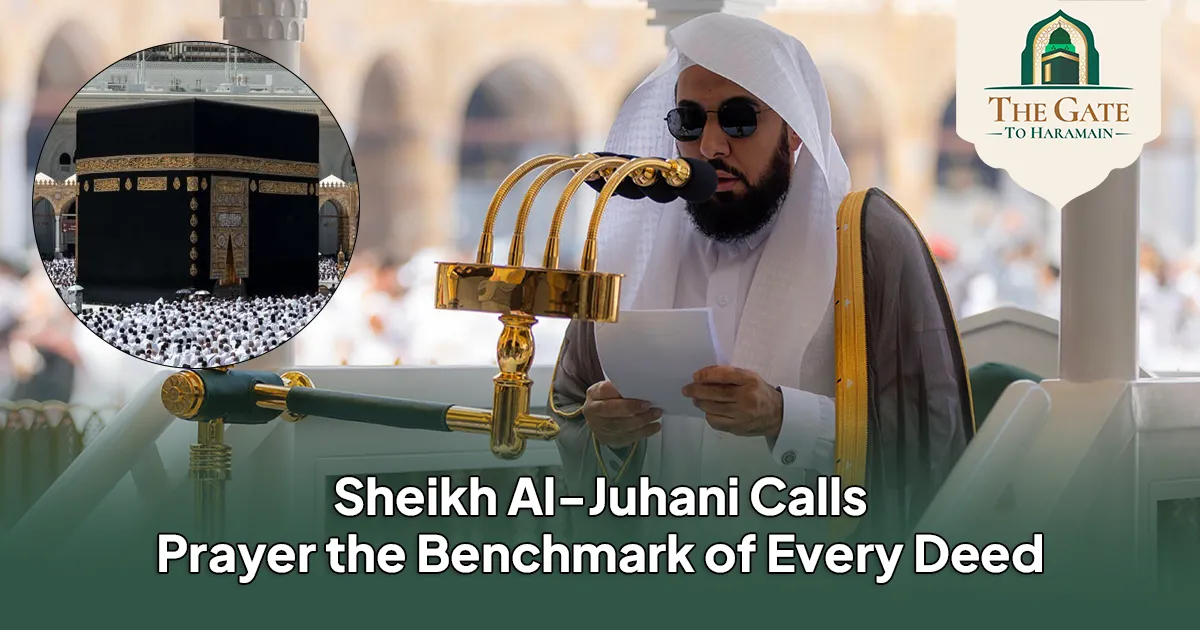
The Imam of Masjid al-Haram urged worshippers to guard the time, conditions, and humility of their prayer and condemned the attack on King Khalid International Airport in Riyadh.
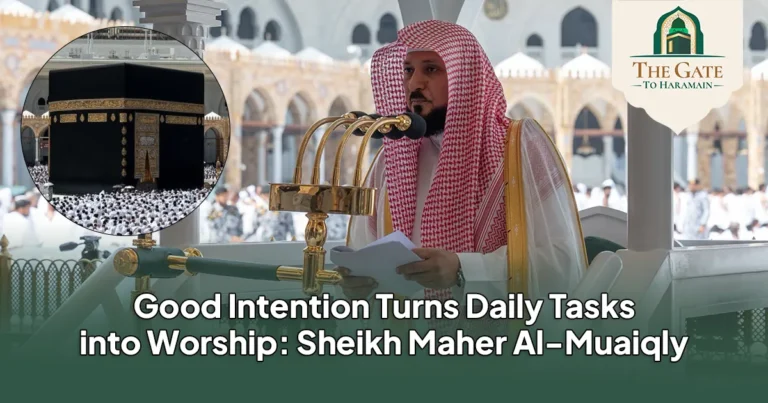
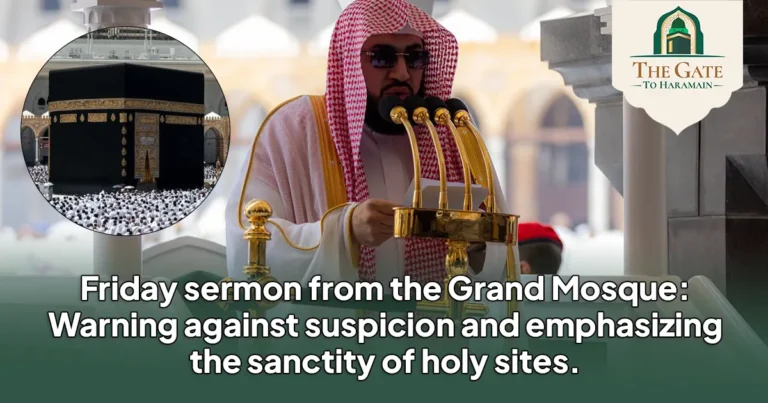
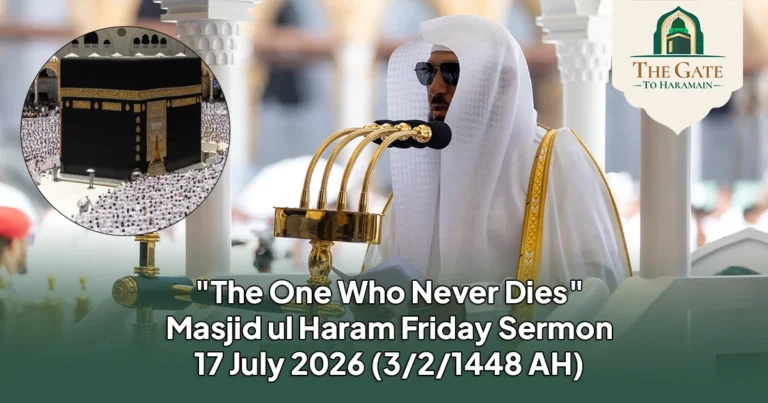
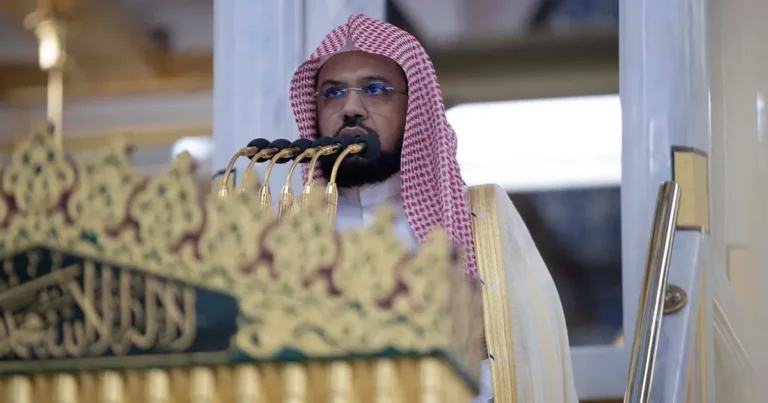
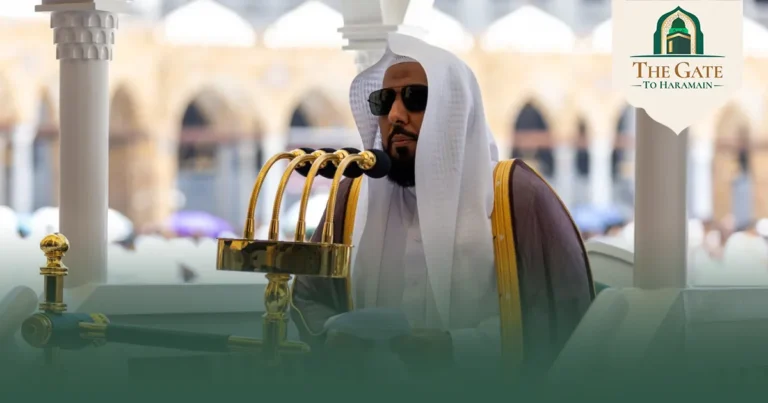
MAKKAH — His Eminence Sheikh Dr. Abdullah bin Awad Al-Juhani delivered this Friday’s sermon at Masjid al-Haram, devoting the first khutbah to the place of the obligatory prayer (Salah) in a Muslim’s life. He told the congregation that fearing Allah in every state, together with diligent upkeep of the obligatory prayers, is the way to fulfill human hopes and be saved from divine punishment.
In the second khutbah, the Sheikh condemned the Houthi militia’s attack on King Khalid International Airport in Riyadh and urged worshippers to turn to prayer in times of distress. He then led the congregation in the two-unit Friday prayer.
Key points
- Prayer is the foundation of the religion, the second pillar of Islam, and the benchmark by which other deeds are measured.
- The Sheikh cited a hadith reported by Jabir ibn Abdullah in Sahih Muslim: abandoning prayer stands between a servant and disbelief.
- Worshippers were warned against rushing. Calm and humility are the “soul” of prayer.
- No worldly matter, including business, sport, or celebrations, excuses delaying prayer beyond its time.
- The second sermon condemned the attack on King Khalid International Airport and included prayers for the protection of Saudi Arabia.
Taqwa and prayer: the opening message
Sheikh Abdullah bin Awad Al-Juhani opened with the customary praise of Allah, thanking Him for commanding His servants to maintain their prayers and for preparing the greatest rewards for those who perform them well. After the testimony of faith and blessings upon Prophet Muhammad ﷺ, his family, and his companions, he set out his central message: pious fear of Allah (taqwa) in every state and careful preservation of the obligatory prayers.
He described prayer not as one religious practice among many, but as the foundation on which the religion stands and the central pillar of the whole structure of Islam.
Prayer as the measure of every deed
Citing the hadith narrated by Jabir ibn Abdullah and recorded in Sahih Muslim, Sheikh Al-Juhani recalled the words of the Prophet ﷺ: “Between a servant and disbelief and polytheism is the abandonment of prayer.” For this reason, he said, prayer serves as the benchmark of human action. When a person’s prayer is sound, the rest of their deeds are sound. When it is neglected, other deeds become even more prone to corruption.
He reinforced the point with the directive of Amir al-Mu’minin Umar ibn al-Khattab (may Allah be pleased with him) to his governors: “The most important of your affairs to me is prayer. Whoever preserves it and maintains it preserves his religion, and whoever neglects it will neglect other matters even more.”
Conditions, pillars, and the warning against rushing
Sheikh Dr. Abdullah bin Awad Al-Juhani described prayer as the direct bond between creation and the Creator, one that lifts a person above worldly distractions toward the reward Allah has prepared for the righteous, which “no eye has seen, no ear has heard, and no human heart has ever conceived.” To reach that standard, he said, prayer must be performed according to divine guidelines:
- Purification (taharah): with water, or with clean earth (tayammum) when water is unavailable, or a person cannot use it because of illness or hardship.
- Covering the ‘awrah with proper clothing.
- Facing the Qiblah, toward the Sacred Mosque in Makkah, wherever one is.
- Sincere intention (ikhlas) for Allah at the opening takbir.
- The essential pillars: recitation, bowing (ruku’), prostration (sujud), sitting, standing upright after bowing, and tranquility (tuma’ninah) throughout.
He warned worshippers against “pecking” the prayer like a crow. The absence of tranquility and humble devotion (khushu’), he said, invalidates the prayer, because the two are its very soul.
Refuge in hardship and a shield against wrongdoing
Sheikh Abdullah bin Awad Al-Juhani said that the prayer is also a source of resilience: “the sweet water in times of thirst, the provision in times of hunger, and the strength in times of weakness.” He noted that the Prophet ﷺ would hasten to prayer whenever a difficult matter pressed upon him, and that intimate conversation with Allah (munajat) calms the heart and restores resolve.
He cited the verse in Surah Al-Ankabut (45) that prayer prohibits immorality and wrongdoing, together with Ibn Abbas’s explanation that prayer holds a restraint against disobeying Allah. Not every performance of prayer achieves this, the Sheikh said. It does so when three conditions are met:
- It is for Allah alone, free of ostentation (riya’) and self-admiration (‘ujb).
- The heart is present and understands what is being recited.
- It follows the guidance of the Prophet ﷺ.
No worldly excuse for delaying prayer
Quoting Surah An-Nisa (103), that prayer has been decreed upon the believers “a decree of specified times.” Sheikh Dr. Abdullah bin Awad Al-Juhani said no worldly pursuit justifies delaying a prayer past its time. He named commercial dealings, craftwork, sports matches, meetings, and celebrations, and added that event organisers have a duty to provide space and reminders for prayer.
He pointed to extreme circumstances to show that the obligation is never dropped:
- On the battlefield: soldiers facing an enemy must still pray on time, as set out in Surah An-Nisa (102) on the prayer of fear (Salat al-Khawf).
- In severe illness: a sick person who retains their faculties prays according to their ability, and what they genuinely cannot perform falls away, since Allah does not burden a soul beyond its capacity.
- After sleep or forgetfulness: the Prophet ﷺ instructed, in a narration from Anas ibn Malik in Sahih al-Bukhari and Sahih Muslim, that the prayer be performed as soon as it is remembered.
Sheikh Al-Juhani also urged parents to instruct their children to pray and to insist on it within the household. He reminded worshippers to gather provisions for the Day of Resurrection and not to be deceived by the passing allurements of worldly life. The first sermon closed with verses from Surah Al-Mu’minun (9–11) and Surah Al-Ma’arij (34–35), which describe the reward of those who safeguard their prayers, including inheritance of Al-Firdaus, the highest part of Paradise.
Second sermon: condemnation of the airport attack
In the second khutbah, Sheikh Dr. Abdullah bin Awad Al-Juhani addressed what he called an immediate crisis: the Houthi militia’s attack on King Khalid International Airport in Riyadh. He condemned the strike on civilian infrastructure, international travelers, innocent civilians, and pilgrims (mu’tamireen) as a heinous crime and a violation of the sanctity of human life. He called it an act of terrorism that no religion or political cause can justify and a form of corruption on earth, reminding the congregation that Allah does not love the corruptors.
Turning to spiritual guidance, he cited Surah Al-Baqarah (153): “Seek help through patience and prayer. Indeed, Allah is with the patient.” He urged the community to take refuge in prayer and supplication, trusting that Allah can turn hardship into ease and fear into security.
The Sheikh then led a series of supplications:
- Blessings upon the Prophet ﷺ, the four Rightly Guided Caliphs (Abu Bakr, Umar, Uthman, and Ali), the Companions, and their followers.
- A prayer against the Houthi aggressors and their supporters, asking Allah to frustrate their plans and scatter their ranks.
- Protection for the Kingdom of Saudi Arabia from plots, envy, and injustice.
- Guidance and strength for the Custodian of the Two Holy Mosques, King Salman bin Abdulaziz, and Crown Prince Mohammed bin Salman.
- Steadfastness for the border guards defending the nation’s frontiers, healing for the wounded, and acceptance of the fallen as martyrs.
- Forgiveness for all believers, relief for the distressed, repayment of debts, healing for the sick, and abundant rain (Istisqa’).
The sermon closed with the Quranic exhortation in Surah An-Nahl (90) to justice, good conduct, and giving to relatives.
The Jumu’ah prayer
After the Iqamah, the Imam led the two-unit Friday prayer. In the first rak’ah, he recited Surah Al-Fatihah, followed by Surah Al-Fil and Surah Quraysh. In the second rak’ah, he recited Surah Al-Fatihah, followed by Surah An-Nasr. The prayer ended with the tasleem to the right and left.
What the sermon asks of worshippers
The message of the khutbah was practical. Pray each prayer within its time, perform it with calm and a present heart, follow the Prophet’s ﷺ method, and teach it to the household. In the Sheikh’s framing, steady prayer is both the measure of a believer’s deeds and their first refuge when fear or hardship arrives.