What Is Real Success? Masjid An Nabawi Friday Sermon 6 Nov 2026 (19 Jumada al-Awwal 1448 AH)
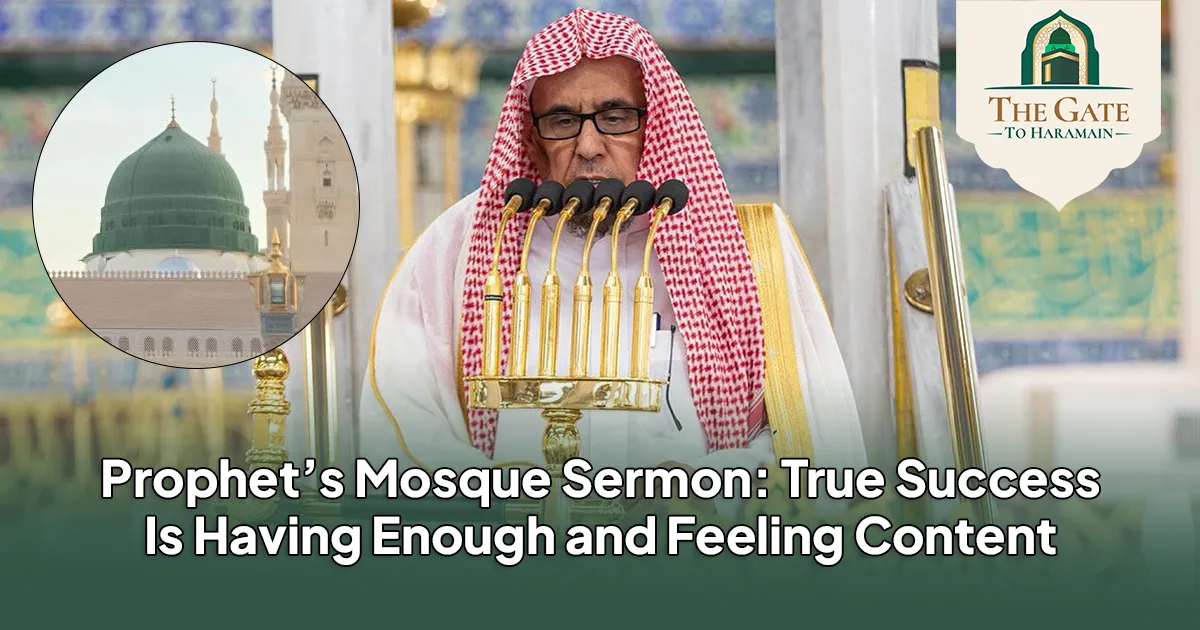
Madinah | Friday 6 November 2026 (26 Jumada al-Awwal 1448 AH)
Everyone wants to succeed. Hardly anyone agrees on what that looks like. Today’s Friday sermon at Al-Masjid an-Nabawi in Madinah went straight at the question and landed somewhere far from bigger salaries and bigger houses. Sheikh Dr. Hussein Al-Sheikh delivered both sermons and led the prayer. Here is what he said, in plain terms, and why it speaks to anyone who has felt that “enough” keeps moving further away.
The sermon at a glance
- Khateeb and Imam: Sheikh Dr. Hussein Al-Sheikh
- Mosque: Al-Masjid an-Nabawi (the Prophet’s Mosque), Madinah
- Date: Friday, 26 Jumada al-Awwal 1448 AH (6 November 2026)
- Main theme: Al-Falah, true success in this life and the next
- Also covered: contentment, the greed of the soul, steadiness in hardship, repentance, remembrance of Allah, unity
What “success” means in the Quran
He opened with praise of Allah and a call to taqwa, God-consciousness, quoting Surah Al-Ahzab (33:70–71): “O you who have believed, fear Allah and speak words of appropriate justice. He will [then] amend for you your deeds and forgive you your sins.”
Then came the main question. Every human being, he said, is chasing al-falah. The word covers three things at once: getting what you love, achieving what you want, and being saved from what you dread. Success, in other words, is fulfillment and safety together.
Islam, he explained, lays out the road to that for both this world and the next. He pointed to Surah Al-Mu’minun (23:1), “Certainly will the believers have succeeded,” and to the opening verses of Surah Al-Baqarah (2:1–5). The people described there believe in the unseen, keep up their prayer, spend from what Allah has given them, trust the revelation, and are certain of the Hereafter.
Notice what is missing from that list. No job title. No bank balance.
Faith that shows up in how you live
The sheikh was clear that faith is not something you keep in a drawer. True faith, he said, shows its effects in the soul, in daily life, in business dealings, in conduct, and in how a person looks at the world.
He tied this to Surah Al-An’am (6:162–163): “Say, ‘Indeed, my prayer, my rites of sacrifice, my living and my dying are for Allah, Lord of the worlds.'” Everything is handed over to Allah, the ordinary hours included.
In the official summary of the sermon, he also stressed holding to the Quran and the Sunnah, pure tawhid (the oneness of Allah), and the way of the Prophet, his companions, and the early generations. Allah, he reminded the congregation, defends the people of true faith (Surah Al-Hajj, 22:38). And real security comes to those who do not mix their belief with injustice (Surah Al-An’am, 6:82).
Enough is a kind of success
This was the part that stayed with me as I reread the sermon, and I suspect it will stay with you too.
The khateeb quoted a hadith recorded in Sahih Muslim: “Successful is the one who submits to Islam, is granted sufficient sustenance, and whom Allah has made content with what He gave him.”
Read it slowly. Submission. Sufficiency. Contentment. The Prophet (peace be upon him) did not say “successful is the one who has the most.” The Arabic word used is kafaf, which means enough to get by on. Add qana’ah, the quiet satisfaction with what you have, and you get a definition of success that no market crash can touch.
It is also a definition most of us fall short of, which is rather the point.
The greed that ruins people
If contentment is the goal, what stands in the way? The sheikh named it shuhh an-nafs, the stinginess and greed of the soul.
He cited Surah Al-Hashr (59:9), “And whoever is protected from the stinginess of his soul, it is those who will be the successful,” and then a warning from the Prophet (peace be upon him) in Sahih Muslim. Beware of injustice, because it will be darkness on the Day of Resurrection. Beware of stinginess, because it destroyed those before you and pushed them to shed blood and violate what was sacred to them.
The sermon then told a short story from the companions. Abdurrahman ibn Awf, one of the wealthiest among them, was seen circling the Ka’bah and repeating one prayer only: “O Allah, protect me from the stinginess of my soul.” Someone asked why he did not ask for more. His answer, as the sermon related it: if he was protected from that, he would not steal, would not commit adultery, and would not do anything forbidden.
That is a bold claim and worth sitting with. Greed here is not only about money. It is the grabbing instinct behind a lot of what goes wrong between people. Hold that in check, and much of the rest never gets started.
Staying steady when life gets hard
The sheikh said faith pays off in two visible ways: it keeps a person away from sinful and shameful acts, and it builds patience and steadiness under pressure.
By nature, he noted, people are anxious. Surah Al-Ma’arij (70:19–23) says humans were created impatient when harm touches them and tight-fisted when good does, except those who guard their prayer. Faith is what changes that default. The Quran also tells believers to stay away from intoxicants and gambling “that you may be successful” (5:90).
And when things get frightening? Remember Allah. He cited Surah Al-Anfal (8:45), “Stand firm and remember Allah much that you may succeed,” and urged the congregation to make dhikr in every situation, especially in hardship. Dhikr is not only a quiet habit for calm moments. It is something to reach for when your hands are shaking.
The door that stays open: repentance
Nobody gets through life without slipping, and the sermon did not pretend otherwise. Surah Al-Qasas (28:67) promises that the one who repents, believes, and does good may be among the successful.
The sheikh reminded the worshippers that all the children of Adam make mistakes and that the best of them are those who keep coming back in repentance. He pointed to the Prophet himself. Even with his past and future sins forgiven, the Prophet (peace be upon him) sought forgiveness and turned to Allah about 70 times a day in the report in Sahih al-Bukhari and 100 times a day in Sahih Muslim. If he did that, what excuse is left for the rest of us?
The call was to make repentance a daily habit, in private and in public.
Standing together
The first sermon closed with the community. The khateeb urged believers to advise one another toward truth, to cooperate in good, and to keep alive the duty of enjoining what is right and forbidding what is wrong, citing Surah Ali ‘Imran (3:104). Unity of word and cooperation in righteousness, he said, are among the reasons for success and for safety from harm.
In the second sermon, he spoke about Saudi Arabia, saying the kingdom was founded on upholding the word of tawhid, applying Islamic law and the Sunnah, and supporting Muslim causes. He said Allah continues to repel the schemes of its enemies, and he called on Muslims to be certain of Allah’s protection and to stand united. He ended with Surah Ali ‘Imran (3:200): “O you who have believed, persevere and endure and remain stationed and fear Allah that you may be successful.”
The closing prayers
The supplications that followed covered a lot of ground. The khateeb prayed for forgiveness for Muslims living and deceased, for relief from worry and distress, and for the Custodian of the Two Holy Mosques and the Crown Prince, along with the security and prosperity of the country.
He also made specific prayers, as reported in the sermon: for the soldiers on the borders, against the Houthi group, which he described as aggressive and transgressing, and for the Muslims of Palestine, a plea he repeated three times. He then called on Allah three times as al-Mughith, the Reliever, and asked three times for beneficial rain across Muslim lands.
How the prayer echoed the sermon
The Friday prayer itself followed. In the first rak’ah, the imam recited the final verses of Surah As-Saffat (37:171–182), which speak of Allah’s word going ahead for His messengers that they will be given victory. In the second, he recited the closing verses of Surah Adh-Dhariyat (51:56–60): jinn and mankind were created only to worship Allah, who needs no provision from them and is Himself the Provider.
The fit with the sermon is neat. The first passage matches the message that Allah defends the believers. The second brings the whole talk back to its root: you were made to worship, not to hoard.
Three things to take home
Strip the sermon down and three questions are left.
- What is my “enough”? If you cannot name it, no amount will satisfy you.
- Where is my shuhh showing up? Ask Abdurrahman ibn Awf about your own habits.
- When did I last turn back to Allah? Not last Ramadan. Today.
Success, as the Prophet’s Mosque heard it this Friday, is not a finish line. It is a way of living: content with what Allah gave, careful with your own greed, quick to repent, and steady because you remember Him.
If this reminder helped, share it with someone who might need it before the weekend.
Sources: the official summary of today’s sermon from the Presidency of Religious Affairs at the Grand Mosque and the Prophet’s Mosque, and a transcript of the full sermon. Quranic verses and hadith are given in English translation; please check wording against a trusted translation before quoting.