“Raise Them Right” Masjid An Nabawi Friday Sermon 24 July 2026 (10 Safar 1448)
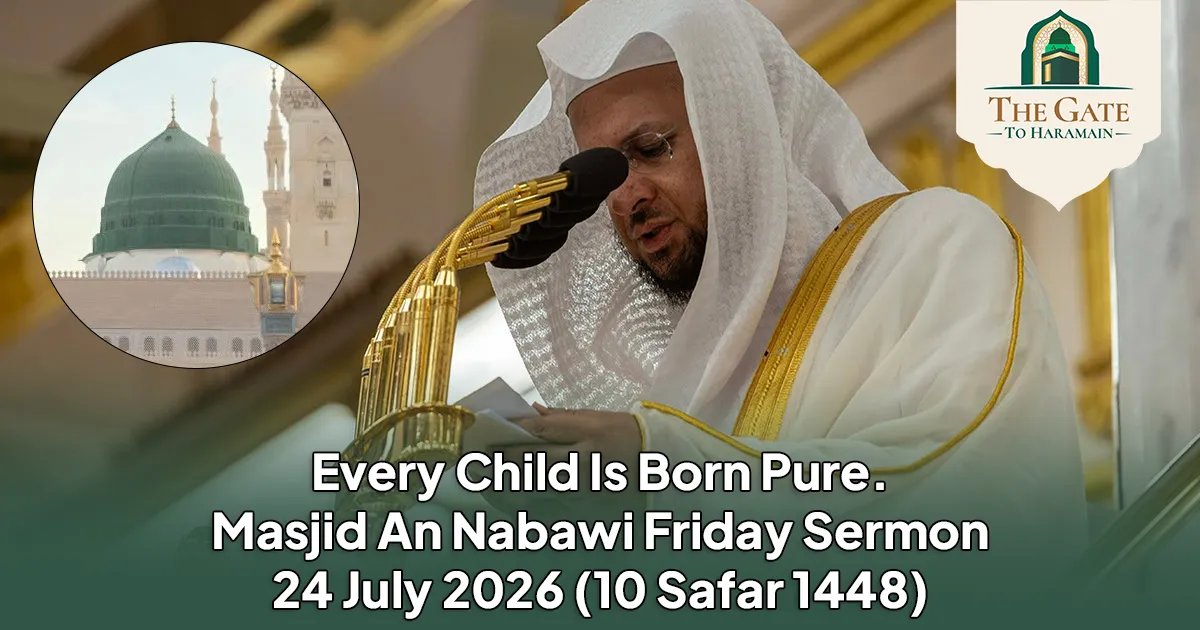
Today’s Friday sermon delivered by Sheikh Abdul Muhsin Al Qasim at the Masjid An Nabawi in Madinah was for every parent sitting in the congregation, and every parent who was not. The Khateeb spent the khutbah on a subject that touches nearly every household in the Ummah: how to raise a child who grows into a person of faith, not just a person who happened to be born into a Muslim home.
The starting point was simple. Children are not an accident of biology or a private achievement. They are an Amanah, a trust placed in a parent’s hands, and one that will be asked about.
A Gift Before It Is a Responsibility
Before the Friday Khutbah at Masjid An Nabawi turned to duty, it lingered on gratitude. Sheikh Abdul Muhsin Al Qasim reminded the congregation that a child is first a favor from Allah, not a burden or a task list. He pointed to the stories of Prophets Ibrahim, Zakariya, and Dawud, and to Maryam, where a child’s arrival is announced as glad tidings, not simply expected.
“Wealth and children are the adornment of the life of this world,” he said, quoting the Quran, an easy line to read past but worth sitting with. Children are not described here as an obligation. They are described as beauty. The joy comes first. The responsibility follows from it, not the other way around.
Protecting the Fitra Before Anything Else Is Taught
The heart of the khutbah was about a child’s Fitra—the natural, unspoiled disposition every human being is born with. “Every child is born upon the Fitra,” the Khateeb reminded the congregation, quoting the well-known hadith. The question a parent has to answer, he said, is not whether that nature exists. It is what gets built on top of it.
He laid out the order plainly:
- Tawhid comes first. Before anything else is taught, a child needs to understand that there is one God. Everything else in their religious education sits on that foundation.
- Faith before Quran, not instead of it. The Khateeb pointed to how the Companions raised their own children: belief was established first, and the Qur’an was learned afterward, so that memorization deepened faith rather than substituting for it.
- The Quran itself does the rest. Once that foundation is there, teaching a child the Qur’an early fills the heart with what he called the “lights of wisdom,” not as a chore to finish, but as something that shapes how a child sees everything else.
“Preserve Allah, and He Will Preserve You”
One line from the sermon is worth remembering on its own. It is the advice the Prophet ﷺ once gave to a young Ibn Abbas: “Preserve Allah, and He will preserve you.” Not a rule. Not a threat. A relationship and the Khateeb treated it as the real foundation of a child’s success, more than grades or discipline or any of the things parents usually worry about first.
From there, the sermon turned to Salah. Parents were told directly to start commanding their children to pray at age seven, well before it becomes obligatory on the child. The Khateeb connected this to something practical, not just spiritual: The Khateeb said that establishing prayer in a household is itself a means through which Allah brings Rizq (sustenance) into that home.
How the Prophet ﷺ Actually Treated Children
This was the part of the sermon that felt least like a lecture and most like a portrait. The Khateeb described in detail how the Prophet ﷺ behaved around children, and none of it looks like strict discipline from a distance.
He kissed his children and smelled them. He joked with them. He greeted young boys he passed in the street, the same greeting he’d give an adult.
Then came the example that seemed to land hardest with the congregation. During a gathering, the Prophet ﷺ asked a young boy’s permission before serving the elders present first, since the boy was seated to his right and had the first claim to what was being served. The boy said no and wanted his own turn before the elders got theirs. And the Prophet ﷺ honored that. Not because the boy outranked the elders, but because his right was his right, and age did not erase it. That’s not a small detail. It’s a statement about how children are owed dignity, not just affection.
The Khateeb also brought up Zaid bin Thabit, how the Prophet ﷺ noticed the boy’s sharpness early and, rather than keeping him at general studies, pointed him toward learning other languages so he could serve as a translator. The lesson for parents: pay attention to what a child is actually good at, and build toward that instead of a generic path.
Children Copy What They See, Not What They Are Told
“What is good to them is what the parent does, and what is ugly is what the parent avoids.” That line did a lot of work in the sermon. The Khateeb’s point was that a child’s moral compass is calibrated by watching, not by being lectured to; parents are the mirror, whether they intend to be or not.
He also spoke about protection in a more literal sense: teaching children the morning and evening Duas, and to seek refuge in Allah’s perfect words, as a shield against harm. Not superstition, but a habit built early enough that it becomes instinct.
Dua: The Tool Parents Underuse
If there was one thing the Khateeb wanted parents to walk away doing more of, it was making dua for their children. He said plainly that there is no cause more beneficial to a child’s righteousness than a parent’s prayer for them, more beneficial, in his framing, than any single thing a parent might do or say.
He cited two examples. Ibrahim’s dua for his descendants, recorded in the Quran Pak. And the Prophet’s ﷺ own dua for the young Ibn Abbas, not for wealth or worldly success, but that Allah grant him deep understanding of the Din. That’s a specific kind of prayer. Not “make my child successful.” Make my child understand.
A Legacy That Outlives the Parent
The sermon closed on something most parents do not think about until much later in life: a righteous child keeps giving back to a parent after that parent has died. The Khateeb brought up the story of Prophet Yaqub on his deathbed, asking his sons a single question: Who will you worship after I am gone? And their answer, without hesitation, was the One God their father had worshipped.
That was the note the khutbah ended on. Not advice about school, or manners, or screen time. A reminder that what a parent plants now is what keeps growing long after they are not around to tend it.
The message from Friday Khutbah at Masjid An Nabawi today was direct: raising a child in faith is not one task among many. For a parent, it may be the one thing that outlasts everything else they do.
Also read: When Divorce Becomes the Last Resort – Masjid An Nabawi Friday Sermon 17 July 2026 (3/2/1448 AH)