Knowledge Is the Greatest Gift One Person Can Give Another: Prophet’s Mosque Friday Sermon 28 August 2026 (15 Rabi al-Awwal 1448 AH)
Most khutbahs about the new academic year stick to the obvious: study hard, respect your teachers, don’t waste the year Allah gave you. This one went somewhere deeper.
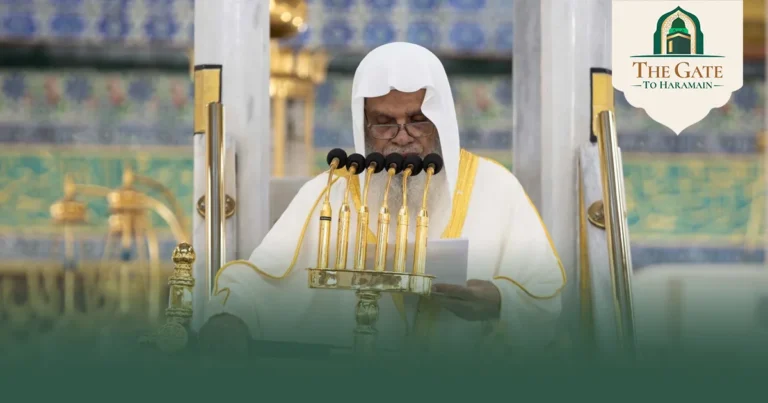
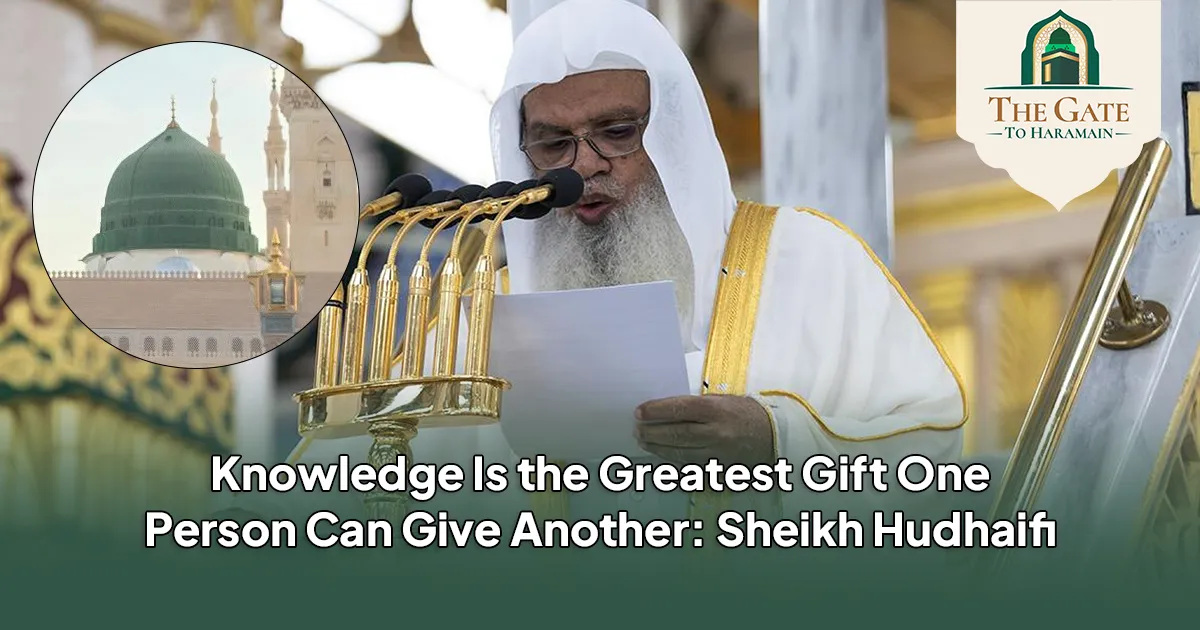
Delivering the Friday sermon from the pulpit of Al-Masjid an-Nabawi in Madinah, Sheikh Dr. Ali bin Abdul Rahman Al-Hudhaifi didn’t treat education as a school-supplies-and-timetables kind of topic. He framed it as amanah, a sacred trust, and walked the congregation through what that trust actually costs, and who’s carrying it.
Here’s what he said, and why it matters beyond one Friday in Madinah.
Nobody Is Born Knowing Anything
Sheikh Al-Hudhaifi opened with a point that sounds almost too simple to preach on: every single human being enters the world knowing nothing. Not a little. Nothing.
He grounded it in two verses. From Surah An-Nahl: “And Allah brought you out from the wombs of your mothers not knowing a thing, and He gave you hearing, sight, and hearts, so that you might be grateful.” (16:78) And from the very first revelation given to the Prophet ﷺ, Surah Al-Alaq: “Read, in the name of your Lord who created. He created man from a clinging substance. Read, and your Lord is the Most Generous, who taught by the pen, taught man that which he did not know.” (96:1–5)
That second one is worth sitting with. The first thing Allah revealed to humanity wasn’t a rule or a warning. It was a command to read. And a reminder that whatever we know, we know because He taught us. Al-Hudhaifi’s point: knowledge isn’t a possession you accumulate. It’s a gift you’re handed, piece by piece, by a Lord who is Al-Alim, the All-Knowing.
And what does real knowledge actually do? Per the sermon, it enlightens the mind, purifies the soul, points toward everything good, and holds a society together. Which is why, he said, education is the single greatest gift one person can give another. Not money. Not property. Knowledge.
Children Don’t Listen. They Watch.
This is the part of the sermon that hits differently once you’ve actually raised a child, or taught one.
Al-Hudhaifi made a specific developmental point: a young child cannot yet balance options or reason things through. He hasn’t got the tools for it. So the child doesn’t learn from what he’s told. He learns from what he sees. He copies. He absorbs. Every gesture, every reaction, every unguarded moment becomes curriculum, whether the adults in the room intended it that way or not.
That puts an enormous weight on two groups.
Parents carry it first. The sermon cites the well-known hadith reported by Al-Bukhari and Muslim: “Every child is born upon the fitrah, the natural disposition, then his parents make him a Jew, a Christian, or a Magian.” It’s a stark line, and it’s meant to be. The child arrives with a clean slate pointed toward truth. What happens after that is largely on the household.
Teachers carry it next. Once the child leaves the home, the school inherits a version of the same trust. Not just to instruct. To model. A teacher who says the right things while modeling the wrong ones is, in practice, teaching the wrong things. Children don’t file that under “do as I say.” They just watch, and absorb, and repeat.
Prayer at Seven, Discipline at Ten
The sermon then moved to something concrete: the early religious grounding every Muslim child needs before anything else gets layered on top.
Al-Hudhaifi cited the hadith narrated by Ahmad and Abu Dawud: “Command your children to pray when they are seven, and discipline them for it when they are ten, and separate their beds.” It’s a staged instruction: start early, hold the line as they grow, and don’t wait until adolescence to introduce structure that should already be second nature by then.
His argument was practical, not just spiritual: a child raised on prayer and good character tends to stay on that path. Neglect it early, and you are trying to fix in the teenage years what should have been built in early childhood. A much harder rebuild. Done right, that child becomes what the sermon calls a labnah salihah: a righteous building block. Someone who adds to their community instead of draining it.
Medicine, Engineering, and the Myth of “Secular” Knowledge
Here’s where the sermon pushes past the expected and into something a lot of khutbahs skip entirely.
Once a young person has that religious and moral foundation, Al-Hudhaifi said, the next step is choosing a specialization suited to their talents. And he named the fields explicitly. Medicine. Engineering and urban development. Agriculture and food security. Manufacturing. Economics and administration. Social sciences. Military and security sciences. Advanced technology.
He wasn’t listing career options. He was making an argument: a Muslim community that produces excellent scholars but no doctors, no engineers, no agronomists — a community dependent on others for its food, its medicine, its infrastructure, its defense has failed a collective obligation. Not a personal one. A communal one.
He backed the religious core of that framework with a hadith narrated by Ahmad, Abu Dawud, Al-Tirmidhi, and Ibn Majah: “The scholars are the heirs of the Prophets. The Prophets left behind neither dinar nor dirham. They left behind knowledge, and whoever takes it takes an abundant share.” And alongside that, mastery of Arabic itself, since understanding scripture properly runs straight through the language it was revealed in.
But the sciences that keep a society standing on its own feet? Those aren’t a distraction from religion. In Al-Hudhaifi’s framing, they’re how a community fulfills its obligations in the world Allah placed it in.
Can Studying Engineering Be an Act of Worship?
The second half of the sermon tackled a question that a lot of students quietly carry: does studying medicine or engineering count for anything spiritually, compared to studying fiqh or hadith?
Al-Hudhaifi’s answer wasn’t a simple yes. He said that the religious knowledge does hold a higher rank on its own terms. Its benefit reaches into the eternal life, while worldly knowledge serves needs that end with this world. That’s the honest hierarchy.
But then comes the turn. If a believer studies medicine, or engineering, or agriculture with the intention of benefiting people and seeking Allah’s reward through it, Allah writes for them the full reward anyway. The knowledge itself doesn’t have to be religious for the intention behind it to make it an act of worship.
He anchored this in the hadith every Muslim has heard a hundred times but rarely applies this specifically: “Actions are judged by intentions, and every person will have only what they intended.” Followed by the old scholarly saying that the believer’s intention outweighs his action. In other words: the surgeon who operates to serve people and please Allah, and the scholar who teaches tafsir to serve people and please Allah, can be standing in the same spiritual place. The field doesn’t decide that. The niyyah does.
He added one more detail worth remembering: Allah taught Adam the names of all things before He asked the angels to prostrate, establishing, from the very beginning, that knowledge comes before action. Even in the Quran, a trained hunting dog’s catch is made lawful to eat while an untrained dog’s is not (Surah Al-Ma’idah, 5:4). A small detail, but a pointed one. If training elevates an animal’s status under divine law, what does knowledge do for a human being created to worship?
What He Asked of Everyone, By Name
The sermon closed the way a good khutbah should: not with a summary, but with a direct assignment for everyone sitting in the mosque.
To education officials: treat your position as the trust it is, and carry it out with diligence. To parents: work with the schools, don’t leave the job to them alone. To students, as the term begins: start with high aspiration and the words “Bismillah wa ala barakatillah,” in the name of Allah and upon His blessing.
And he ended on Surah At-Tawbah: “Say: work, for Allah will see your work, and so will His Messenger and the believers.” (9:105)
Why This One Is Worth Sharing
If you are a parent gearing up for a new school year, or planning a pilgrimage and following the sermons from the two Harams as part of that spiritual rhythm, this khutbah is one to actually sit with rather than skim. It reframes something most of us treat as purely practical- school, careers, degrees- as an extension of worship, provided the intention is there.