
Where Does Your Rizq Really Come From? 7 Simple Lessons – Masjid al-Haram Friday Sermon 4 September 2026 (22 Rabi al-Awwal 1448 AH)

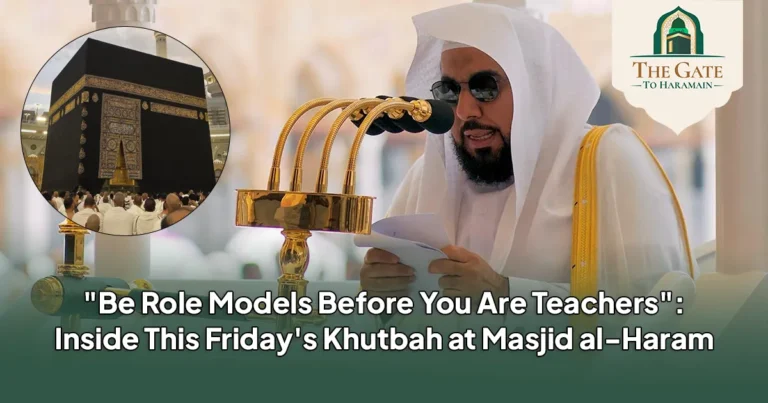
Friday sermon at Masjid al-Haram, Makkah, delivered by His Eminence Sheikh Dr. Osama bin Abdullah Khayyat — Rabi’ Al-Awwal 22, 1448 AH / September 4, 2026
Quick question: when you think about “getting stuff” — money, food, a nice home, good friends — who do you think is actually in charge of all that?
This Friday’s sermon at the Grand Mosque had one big answer: it’s Allah. Not luck. Not just how hard you work. Allah.
Sheikh Dr. Osama bin Abdullah Khayyat opened his khutbah with some simple advice: fear Allah, be honest in how you worship Him, do good deeds, turn back to Him when you mess up, trust Him, and use this world to prepare for the next one.
The Arabic word for this is Rizq, and it means way more than money. Rizq is:
- The food on your plate
- The home you live in
- Being healthy
- Good friends and family
- Even the knowledge you learn
None of it is something we earned just by existing. It’s a gift. Sheikh Khayyat said it clearly:
“All that sustains a person’s life and makes their existence comfortable… is from the grace, generosity, and benevolence of God Almighty upon His servants.”
Allah is called Al-Razzaq — The Provider — and here’s the wild part: He doesn’t need anything from us. We’re the ones who need Him.
“O mankind, you are those in need of Allah, while Allah is the Free of need, the Praiseworthy.” (Surah Fatir, 35:15)
Once that clicks, something changes. You stop panicking about “will I have enough?” and start focusing on the part you can actually control: how you live.
So how do you open the door to more blessings? The sermon lays out seven keys. Think of them less like magic tricks and more like habits.
1. Actually Care About Doing Right (Taqwa)
This is the foundation. Not faking it — really trying to follow Allah’s rules and stay away from what He’s forbidden.
“And whoever fears Allah – He will make for him a way out and will provide for him from where he does not expect.” (Surah At-Talaq, 65:2-3)
Picture being stuck on a hard homework problem, and then suddenly it clicks from nowhere. That’s kind of what this promises — a way out, from a direction you didn’t see coming.
2. Trust Allah AND Still Do the Work
Here’s a mix-up a lot of people make: they think “trusting Allah” means sitting around doing nothing. Nope.
The scholar Ibn al-Qayyim explained it like this — trust is the heart’s job, and effort is the body’s job. You need both, the same way a head needs a body to stand on.
Even the birds get up and go looking for food every morning. The Prophet (PBUH) said if we trusted Allah the way we should, He’d provide for us the same way He provides for them — they leave the nest hungry and come back full. But notice: they still fly out. They don’t just wait in the nest.
Umar ibn al-Khattab, one of the Prophet’s closest companions, put it bluntly:
“Let none of you sit back from seeking sustenance, saying, ‘O Allah, provide for me,’ when he well knows that the sky does not rain gold or silver.”
Translation: pray for it, then go get up and try.
3. Say Sorry and Mean It
When you mess up, saying sorry to Allah and actually meaning it (this is called Istighfar) isn’t just about wiping the slate clean. The sermon says it can open up real blessings, too.
The Prophet Noah told his people that if they turned back to Allah, He’d send rain, give them more wealth and children, and provide gardens and rivers for them (Surah Nuh, 71:10-12). The Prophet Hud told his people almost the exact same thing.
4. Ask For What You Want
Dua — asking Allah directly — isn’t a last resort. The Prophet (PBUH) called it the heart of worship.
His favorite prayer was short and covered everything:
“Our Lord, give us in this world [that which is] good and in the Hereafter [that which is] good and protect us from the punishment of the Fire.” (Surah Al-Baqarah, 2:201)
Scholars who studied this verse said “good in this world” includes things like: being healthy, having a comfortable home, a good spouse one day, lawful income, useful knowledge, and even something as simple as reliable transportation.
5. Stay Close to Your Family
This one might surprise you: keeping close ties with your family — actually calling your grandma, showing up for your cousins, not letting fights turn into years of silence — is treated as a way to grow your provision, not just a nice thing to do.
“Whoever loves that his sustenance be expanded and his life-span be prolonged, let him maintain his family ties.” (Prophet Muhammad, PBUH)
6. Give — Especially to People Who Have Less
Here’s a paradox: giving your money away is supposed to grow it, not shrink it.
“And whatever you spend of anything, He will compensate it; and He is the best of providers.” (Surah Saba, 34:39)
There’s a hadith that says every single morning, two angels come down. One says, “O Allah, give the giver more.” The other says, “O Allah, destroy the hoarder’s wealth.”
And there’s a bigger point buried in here too. Once, a companion named Sa’d ibn Abi Waqqas felt kind of proud of his own importance. The Prophet (PBUH) corrected him:
“Are you given victory and sustenance except because of the weak among you?”
In other words — a community doesn’t succeed despite the people who need help. It succeeds because of how it treats them.
7. Get Up Early
The Prophet (PBUH) prayed: “O Allah, bless my nation in their early morning hours.”
There’s a great story about this. A companion named Sakhr al-Ghamidi took the advice seriously — he sent his trade caravans out at the crack of dawn, every single time. His business grew so much that, according to the story, he ended up with more money than he knew what to do with.
You don’t need a trade caravan to test this one. Getting your day started early — homework, chores, whatever — tends to just… work better than starting late.
The Warning: Don’t Cheat When You’re Impatient
Sometimes your Rizq feels delayed. Money’s tight, things aren’t working out, and it’s tempting to cut corners — lie, cheat, take a shortcut you know isn’t right.
The sermon has a strong warning against this, based on a hadith:
“No soul shall die until it completes its life-term and fully exhausts its predestined sustenance. So fear Allah, and be beautiful/moderate in your seeking. And do not let the delay of your sustenance lead you to seek it through disobeying Allah — for indeed, that which is with Allah cannot be obtained except through His obedience.”
Basically: whatever is written for you is coming. Cheating won’t make it come faster — it’ll just mean you got something Allah didn’t bless in the first place.
The Prophet (PBUH) summed up the whole rulebook in six words:
“Take what is lawful and leave what is forbidden.”
What to Remember
If you forget everything else, remember this: your provision isn’t something you have to fight the world for. It’s already being written for you. Your job is to show up — pray, work, ask, forgive, give, stay close to family, and start early — and trust the rest to the One who never runs out.
Coverage of the Friday sermon (Khutbah) delivered by His Eminence Sheikh Dr. Osama bin Abdullah Khayyat at Masjid al-Haram, Makkah.